

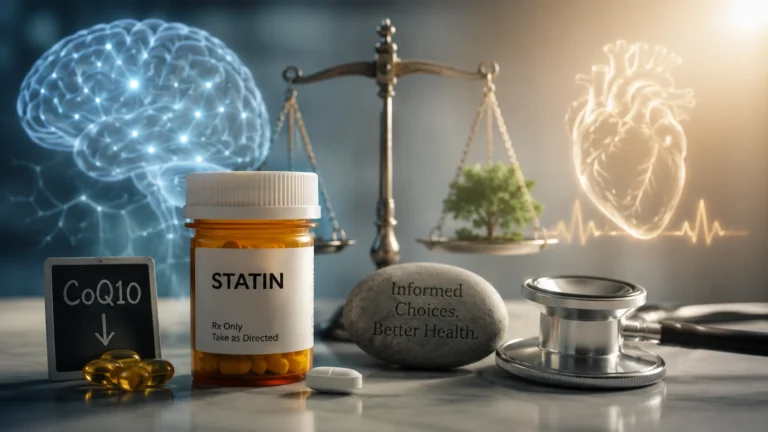
This article is for educational purposes and is not personal medical advice. Statins can reduce heart-attack and stroke risk for some people, especially those with established cardiovascular disease or high calculated risk. At the same time, patients deserve a careful discussion of risks, side effects, nutrient depletion, brain-health concerns, and alternatives. Do not start, stop, or change a prescribed medication without working with a qualified healthcare professional.
Statins are often presented as a simple heart-health solution: lower LDL cholesterol, reduce plaque risk, prevent heart attacks and strokes. For many patients, especially those who have already had a cardiovascular event, that story may be partly true. But it is not the whole story.
Cholesterol is not a poison. It is a building block. The body uses it for cell membranes, steroid hormones, vitamin D metabolism, bile acids, and the nervous system. The brain is especially cholesterol-rich. So when a medication is designed to suppress cholesterol production, the honest question is not only, “Does it lower LDL?” The better question is, “What else changes when this pathway is altered for years?”
That is where statins deserve a closer look. Not panic. Not blind trust either. A careful look.
Health decisions are not about fear, fashion, or pharmaceutical loyalty. They are about stewardship, wisdom, and asking better questions before making long-term commitments.
Table of Contents
What Statins Actually Do
Statins work by inhibiting HMG-CoA reductase, an enzyme in the mevalonate pathway. That pathway is involved in cholesterol production, but cholesterol is not the only downstream product. The same pathway also relates to compounds involved in cell signaling and mitochondrial function, including coenzyme Q10, commonly called CoQ10.
That matters because the statin discussion is often reduced to one number: LDL cholesterol. LDL is important, but the body is not a spreadsheet. When a pathway is suppressed, the effects may ripple through muscles, mitochondria, hormones, the liver, the nervous system, and the patient’s day-to-day energy.
This does not prove that every person on a statin will be harmed. It does mean the decision should be more personal than “high cholesterol equals statin.” Risk level, age, prior heart events, diabetes, blood pressure, inflammation, coronary calcium score, family history, diet, metabolic health, and side effects all matter.
Statins and CoQ10: Energy Production Is Not a Side Issue
One of the most important concerns is CoQ10 depletion. Statins can lower circulating CoQ10 levels. That point is not fringe. It is a predictable concern because statins interfere with the pathway that helps produce both cholesterol and CoQ10.
CoQ10 is not a trendy supplement invented by the wellness industry. It is part of the mitochondrial electron-transport system that helps cells make ATP, the body’s usable energy currency. The heart is one of the most energy-demanding organs in the body. Skeletal muscle is also energy-hungry. So if a patient develops muscle aches, weakness, fatigue, or exercise intolerance after starting a statin, CoQ10 and mitochondrial stress become reasonable topics to discuss with a clinician.
Here is the tension. Studies generally agree that statins lower blood CoQ10, but the clinical benefit of CoQ10 supplementation for statin-related muscle symptoms remains mixed. Some people report improvement. Research overall is not definitive. That is why the best position is neither “everyone on a statin must take CoQ10” nor “CoQ10 does not matter.” The wiser position is: if symptoms appear, ask about CoQ10, mitochondrial function, dose, statin type, thyroid status, vitamin D, drug interactions, and alternative lipid-lowering strategies.
The Brain Is Cholesterol-Rich, But the 95 Percent Claim Needs Correction
It is common to hear that the brain is “95% cholesterol.” That statement is not accurate as written. The stronger evidence-based point is still striking: the brain is the most cholesterol-rich organ, and it contains roughly one-fifth of the body’s cholesterol even though it represents only a small fraction of body weight.
That distinction matters. If we make exaggerated claims, critics can dismiss the whole concern. But if we state the physiology accurately, the concern becomes harder to brush aside. Brain cholesterol is involved in cell membranes, synapses, myelin, and neuronal communication. The brain also maintains its cholesterol largely behind the blood-brain barrier, meaning brain cholesterol and blood cholesterol are related but not the same pool.
So the issue is not simply “cholesterol bad” or “cholesterol good.” The issue is balance, location, timing, and function. Too much LDL in the bloodstream can contribute to atherosclerosis. Too little functional cholesterol in the wrong tissues could be a different kind of problem. A mature health discussion has to hold both realities at once.
Statins, Memory Complaints, and Brain Fog
Patients have reported memory loss, forgetfulness, confusion, and brain fog while taking statins. The FDA-required labeling for statins has acknowledged rare postmarketing reports of cognitive impairment, generally described as nonserious and reversible after discontinuation. That does not mean every memory complaint is caused by a statin. It does mean the experience is real enough to be discussed rather than dismissed.
Large population studies and reviews are mixed. Some find no clear harmful effect on cognition. Some suggest neutral or even protective associations, especially where statins reduce stroke and vascular disease risk. Other research continues to explore whether certain patients may be more vulnerable than others.
This is where patients can feel trapped between two extremes. One side says, “Statins destroy the brain.” The other says, “There is nothing to see here.” Neither extreme is satisfying. If a person begins a statin and soon notices word-finding trouble, confusion, memory decline, fatigue, or emotional dullness, the right response is not internet panic. It is careful documentation and a serious conversation with the prescriber.
Do Statins Cause Brain Shrinkage?
The claim that statins routinely cause brain shrinkage is too strong. The evidence is not settled enough to say that as a blanket fact. Some observational imaging research has reported associations between statin use, lower cholesterol, and differences in brain volumes or white-matter findings. Other studies have found no adverse relationship between long-term statin use and Alzheimer’s-related neuroimaging biomarkers or hippocampal-volume change.
The key word is association. People prescribed statins often have more cardiovascular risk to begin with. They may have diabetes, hypertension, vascular disease, obesity, or inflammation – all of which can affect the brain. That makes it difficult to separate the medication from the underlying risk profile.
Still, the concern should not be ignored. If a drug significantly alters lipid metabolism in a body whose brain depends on cholesterol-rich structures, long-term brain outcomes deserve careful research. The responsible conclusion is cautious: brain-volume concerns are worth watching, but they should not be overstated as settled proof.
The Heart-Health Paradox: Protecting the Heart While Depleting the Heart’s Energy Support
Statins are prescribed to protect the heart. Yet the heart is also deeply dependent on mitochondrial energy. That creates a paradox. A medication may reduce one cardiovascular risk marker while also creating side effects in the very tissues that demand strong energy production.
To be fair, statins have meaningful evidence behind them in higher-risk patients. People with prior heart attack, stroke, certain forms of coronary artery disease, or very high LDL may receive real risk reduction. That should not be dismissed. A person with established cardiovascular disease is not in the same category as a low-risk person prescribed a statin simply because a lab number crossed a threshold.
That is why the question should be individualized. What is the patient’s absolute risk? What is the expected absolute benefit? What dose is being proposed? Are lifestyle measures being used seriously? Is the patient metabolically healthy? Are side effects being monitored? Could a lower dose, different statin, non-statin therapy, or lifestyle-first trial be appropriate?
Other Risks Patients Should Know About
Muscle symptoms are the best-known statin complaint. These can range from mild aches to severe weakness. Rarely, statins are associated with rhabdomyolysis, a dangerous muscle breakdown condition. Liver enzyme changes can occur. Blood sugar may rise in some patients, and statins are associated with a modest increase in diabetes risk, especially in people already metabolically vulnerable.
None of this means statins are always bad. It means side effects should not be waved away as imagination. A patient knows when his energy changes, when her legs feel weak, when sleep changes, when thinking feels cloudy, or when exercise tolerance drops. Those observations belong in the medical conversation.
Better Questions Before Starting or Continuing a Statin
Before accepting long-term statin therapy, patients should ask better questions. Not hostile questions. Honest ones.
What is my actual 10-year and lifetime cardiovascular risk? Have we checked insulin resistance, triglycerides, HDL, blood pressure, waist circumference, inflammation markers, thyroid function, and lifestyle factors? Would a coronary artery calcium scan clarify my risk? Is my risk high enough that the absolute benefit justifies the possible downsides? What symptoms should I track? What alternatives exist if I do not tolerate the drug?
These questions change the tone. Instead of “doctor versus patient” or “medicine versus natural health,” the conversation becomes a shared search for wisdom.
A Wise Path Forward
If you are already taking a statin, do not stop it suddenly because of an article. That is especially important if you have had a heart attack, stroke, stent, bypass surgery, or known coronary disease. Instead, write down your questions and symptoms and take them to your healthcare provider.
If you are considering a statin for primary prevention, make sure the decision is based on your whole risk picture, not fear of a single cholesterol number. Lifestyle still matters: real food, strength training, walking, sleep, blood-sugar control, stress reduction, sunlight, smoking cessation, and healthy body composition are not side issues. They are the foundation of heart and brain health.
Conclusion: Do Not Trade One Risk for Another Without Understanding the Exchange
Statins can reduce cardiovascular risk in the right patient. But they are not a free lunch. They may lower CoQ10, contribute to muscle symptoms, raise concerns about mitochondrial energy, and occasionally coincide with cognitive complaints. The brain’s dependence on cholesterol-rich structures makes simplistic cholesterol thinking especially dangerous.
The strongest argument is not that statins should never be used. The strongest argument is that they should never be used casually. A medication that changes lipid metabolism and mitochondrial-related pathways deserves respect, monitoring, and individualized judgment.
Good health stewardship does not mean rejecting modern medicine. It means refusing to surrender discernment. Ask better questions. Track your symptoms. Strengthen your lifestyle. Know your actual risk. Work with a clinician who listens. And never forget that the goal is not merely a better lab report. The goal is a stronger heart, a sharper mind, and a body capable of serving well for as long as God gives you breath.
Closing CTA
Before accepting long-term statin therapy, ask for a clear explanation of your actual cardiovascular risk, expected absolute benefit, possible side effects, and lifestyle alternatives. If you are already taking a statin and notice muscle symptoms, memory changes, fatigue, or brain fog, do not stop abruptly; document the pattern and discuss it with a qualified clinician.
Source and Fact-Checking Notes
The following sources were used to support key claims, provide background context, and help readers examine the topic more deeply. This article is educational and should not replace guidance from a qualified healthcare professional.
- CDC – How do statins prevent heart attacks and strokes? – https://www.cdc.gov/cholesterol/docs/Statins-English.pdf – Basic public-health explanation of how statins lower LDL and reduce heart-attack or stroke risk.
- USPSTF – Statin Use for Primary Prevention of Cardiovascular Disease – https://www.uspreventiveservicestaskforce.org/uspstf/recommendation/statin-use-in-adults-preventive-medication – Primary-prevention recommendation framework based on risk factors and 10-year cardiovascular risk.
- AHA/ACC – 2019 Primary Prevention Guideline – https://www.ahajournals.org/doi/10.1161/cir.0000000000000678 – Guideline support for statin therapy in selected primary-prevention patients.
- AHA Scientific Statement – Statin Safety and Associated Adverse Events – https://www.ahajournals.org/doi/full/10.1161/ATV.0000000000000073 – Reviews statin safety, including cognitive dysfunction and other adverse-event concerns.
- FDA label language – Rare cognitive impairment reports with statins – https://www.accessdata.fda.gov/drugsatfda_docs/label/2022/020702Orig1s079correctedlbl.pdf – Labeling language noting rare reports of memory loss, forgetfulness, amnesia, memory impairment, and confusion associated with all statins.
- FDA NDA labeling review – statin cognitive impairment language – https://www.accessdata.fda.gov/drugsatfda_docs/nda/2012/021366s024.pdf – FDA review language on reports of cognitive symptoms and lack of evidence for population-level chronic cognitive decline.
- PMC – Cholesterol Metabolism in the Brain and Its Association with Neurodegenerative Disease – https://pmc.ncbi.nlm.nih.gov/articles/PMC6844833/ – Supports the claim that the brain contains approximately 20% of whole-body cholesterol and is highly cholesterol-rich.
- PMC – Cholesterol Regulation and Role in Central Nervous System Disorders – https://pmc.ncbi.nlm.nih.gov/articles/PMC3483652/ – Review of cholesterol’s role in the brain and central nervous system.
- PMC – Statin Treatment and Circulating CoQ10 Meta-analysis – https://pmc.ncbi.nlm.nih.gov/articles/PMC6230224/ – Systematic review/meta-analysis finding statin treatment decreased circulating CoQ10.
- PMC – CoQ10 and Statin-Induced Mitochondrial Dysfunction – https://pmc.ncbi.nlm.nih.gov/articles/PMC3096178/ – Mechanistic review discussing statin-related CoQ10 reduction and possible mitochondrial implications.
- NCCIH – Coenzyme Q10 – https://www.nccih.nih.gov/health/coenzyme-q10 – Federal integrative-health source noting mixed evidence for CoQ10 supplementation and statin muscle pain.
- PMC – Statins and Brain Health – https://pmc.ncbi.nlm.nih.gov/articles/PMC6260813/ – Community-based study finding no adverse or protective differences in Alzheimer’s neuroimaging biomarkers among long-term statin users.
- PMC – Statin Use and Hippocampal Volumes – https://pmc.ncbi.nlm.nih.gov/articles/PMC10833954/ – Older MRI study finding statin use was not associated with rate of hippocampal-volume change.
- PMC – Statin Use and Brain Volumes / White Matter Findings – https://pmc.ncbi.nlm.nih.gov/articles/PMC11606650/ – Observational study reporting associations between statin use, white matter hyperintensity volume, and lower grey matter volumes, with causation limitations.
- Mayo Clinic – Statin side effects – https://www.mayoclinic.org/diseases-conditions/high-blood-cholesterol/in-depth/statin-side-effects/art-20046013 – Patient-facing discussion of statin side effects, including memory loss/confusion warning and evidence context.
