


Learning how to read the Bible for understanding and obedience can protect you from a surprisingly common spiritual mistake: becoming familiar with Scripture without actually understanding what it says or changing how you live. A verse can be quoted accurately and still be applied wrongly when it is pulled from its context, detached from the author’s meaning, or used mainly to confirm what we already wanted to believe.
That is why the goal of Bible reading is not simply to finish chapters, collect favorite verses, or feel inspired. Scripture is meant to teach, correct, train, reveal, warn, encourage, and form the believer. Paul writes that all Scripture is God-breathed and profitable for teaching, reproof, correction, and training in righteousness (2 Timothy 3:16–17). James pushes the same truth into action: be doers of the word, not hearers only (James 1:22).
The practical sequence is simple but demanding: understand before you personalize, interpret before you apply, and apply before you move on as if nothing was asked of you.
| “The goal is not merely to finish the passage. It is to understand what God has said and respond faithfully.” |
Table of Contents
The First Correction: Stop Treating the Bible Like a Collection of Isolated Quotes
Many Bible-reading errors begin before the reader reaches a difficult doctrine. They begin with a basic habit: opening to one sentence and asking immediately, “What does this mean to me?” That question is not useless. It is simply too early.
Every verse belongs to a paragraph. Every paragraph belongs to a larger argument, story, poem, prophecy, letter, or wisdom collection. That book belongs within the whole biblical story. When we skip those layers, personal application can outrun meaning.
A well-known verse may still be misunderstood if its surrounding argument is ignored. A promise to a particular person or nation may not be a universal promise to every reader. A proverb describes wisdom patterns differently from a command. Poetry uses images that should not always be flattened into literal propositions. Revelation is not read in exactly the same way as Romans. Genre and context are not academic obstacles to faith. They are part of listening carefully.
1. Begin With Prayerful Humility
Before you try to master the text, acknowledge that you need God’s help. Prayer reminds you that Scripture is not raw material for private opinion. You are approaching a word that stands over you, not merely a text you stand over.
Psalm 119 repeatedly connects understanding with dependence on God. Jesus likewise connects willingness to do God’s will with discernment of His teaching (John 7:17). A useful opening prayer can be simple: “Lord, help me see what You are saying, understand it truthfully, and obey it faithfully.”
That posture matters because we all bring assumptions, preferences, wounds, traditions, cultural habits, and favorite conclusions to the page. Humility does not mean having no convictions. It means giving the text permission to correct yours.
2. Read the Passage in Context
Context is the first major guardrail against misuse. Before isolating one verse, read enough around it to know what problem, argument, event, or theme the author is addressing.
| Context Question | Why It Matters |
| Who is speaking or writing? | Identifies authority, perspective, and situation. |
| Who is the original audience? | Prevents automatically treating every statement as a direct command or promise to every reader. |
| What comes before and after? | Shows the argument, contrast, reason, or narrative movement. |
| What kind of literature is this? | Genre shapes how language is intended to function. |
| Where does this fit in the biblical story? | Connects the passage to creation, fall, covenant, Christ, church, and restoration. |
The Bereans in Acts 17:11 were commended for examining the Scriptures carefully rather than accepting claims uncritically. Careful reading is not skepticism toward God. It is respect for what He actually said.
3. Observe What the Text Actually Says
Observation sounds simple, but many interpretation mistakes begin because we skip it. Familiarity tempts us to assume we already know what a passage says. Slow down and notice repeated words, contrasts, commands, promises, reasons, warnings, examples, cause-and-effect statements, and conclusions.
A notebook can improve this dramatically. Before reaching for a commentary, summarize the passage in your own words. Ask: What is being emphasized? What problem is being addressed? What does the author say about God, people, sin, grace, wisdom, faith, obedience, or hope?
This step separates listening from projecting. You are forcing yourself to receive the text before rearranging it around your own concerns.
4. Identify the Meaning Before You Make It Personal
This is the central discipline: observation first, meaning second, application third. A passage cannot mean anything we want it to mean. God communicated through real authors to real audiences in real historical settings. Your first interpretive task is to identify what the author intended to communicate.
Ask: What is the author’s main point? Why is this statement here? What argument does it support? What problem does it answer? How would the original audience have understood it?
Only after those questions should you ask, “How does this truth apply to me?” The application may differ across cultures and circumstances while the underlying meaning remains stable.
| ““What does this mean to me?” is usually the wrong first question. First ask, “What does this text mean?”” |
5. Let Scripture Help Interpret Scripture
The Bible is a unified revelation, so clearer passages help us approach harder ones. One obscure verse should not be made to overturn broad, repeated biblical teaching. Cross-references are useful because they reveal how themes develop across Scripture.
This is also one of the best protections against doctrinal overreach. If your interpretation of one sentence contradicts what Scripture repeatedly teaches about God’s character, Christ’s work, grace, sin, repentance, holiness, love, judgment, or salvation, the interpretation deserves another look.
Study Bibles, lexicons, and commentaries can help, but they should assist your reading rather than replace it. Good tools make the text clearer; they should not become authorities above it.
6. Ask What Obedience Requires
Bible reading is not complete when you have an interesting observation. Jesus says the wise person hears His words and does them (Matthew 7:24). James says the hearer who does not act deceives himself. That makes application more than a devotional add-on. It is part of receiving the word faithfully.
End a reading session with practical questions: What should I believe more clearly? What should I repent of? What attitude needs correction? What action should begin? What action should stop? Who should I forgive, encourage, confront, help, or reconcile with? What fear should be brought under trust? What truth should shape today’s decision?
Obedience is not a way to earn salvation. It is the fruit of faith and the practical response of a life being formed by truth. That distinction matters because Christian discipline without grace becomes legalism; grace without obedience becomes sentimentality.
7. Build a Repeatable Practice Instead of Waiting for Inspiration
Understanding grows through repeated exposure. You do not need a complicated system, but you do need a stable one. Choose a realistic time, remove obvious distractions, keep a Bible and notebook together, and stay in one book long enough to see its argument and themes.
Whole-book reading is especially valuable. It reduces the temptation to live on disconnected verses and teaches you to hear biblical authors in extended context. A Gospel, a New Testament letter, a wisdom book, and selected Old Testament narratives can each train different reading muscles.
This practice fits naturally with How to Pray When You Do Not Know What to Say: prayer prepares the posture, Scripture supplies the truth, and obedience turns truth into formation.
It also deepens the broader rhythm described in How to Build a Daily Christian Spiritual Practice, where prayer, Scripture, worship, reflection, service, and accountability work together rather than competing for spiritual attention.
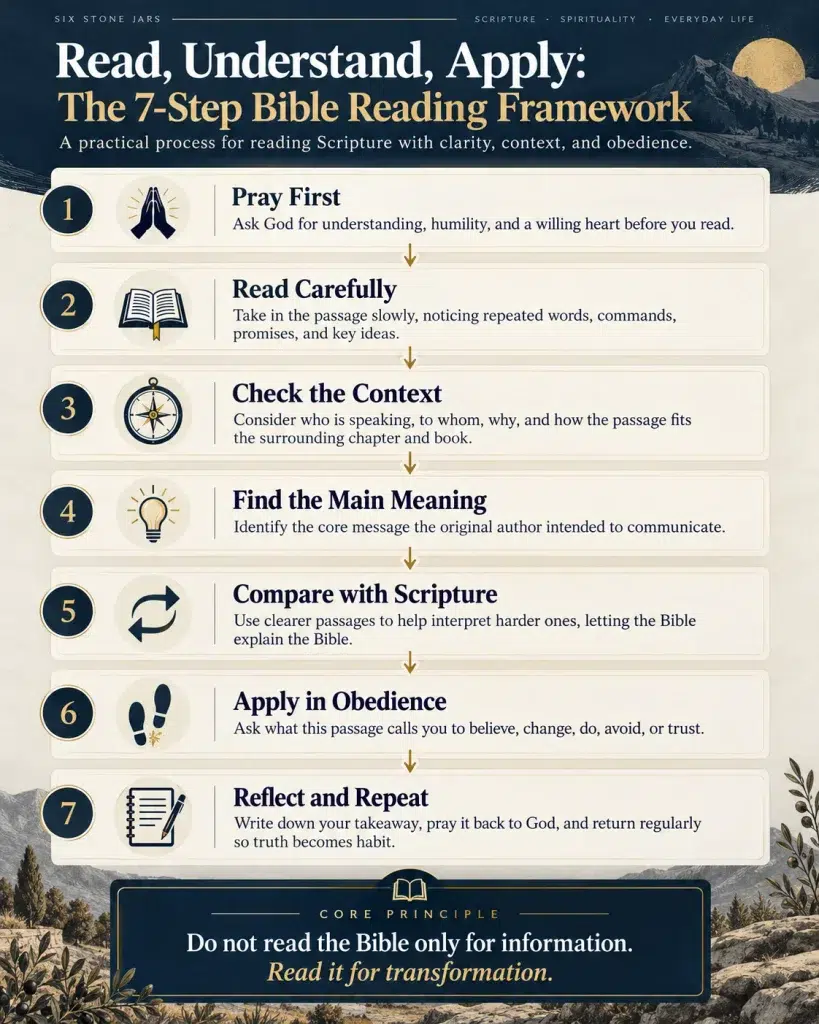
The 7-Step Bible Reading Framework
| Step | Practice | Key Question |
| 1 | Pray for humility | Am I willing to be corrected, not merely confirmed? |
| 2 | Read in context | Who is speaking, to whom, why, and within what genre? |
| 3 | Observe carefully | What does the passage actually say and emphasize? |
| 4 | Identify meaning | What did the author intend to communicate? |
| 5 | Compare Scripture | How does this fit with clearer and repeated biblical teaching? |
| 6 | Choose obedience | What should I believe, repent of, stop, start, or do? |
| 7 | Repeat consistently | How will I return to Scripture before noise resets my thinking? |
Five Red Flags That Should Slow Your Interpretation Down
- Your interpretation depends on one isolated verse while ignoring the surrounding passage.
- You can explain what the verse means to you but not what the author was discussing.
- Your conclusion depends on treating poetry, proverb, narrative, or apocalyptic imagery as though each functions like a direct command.
- Your reading flatly contradicts clearer, repeated biblical teaching elsewhere.
- The application conveniently confirms your preference but never challenges your behavior.
Five Green Flags That Increase Confidence
- You can summarize the passage’s main point in its own context.
- Your interpretation accounts for genre, audience, and the surrounding argument.
- Other clear biblical passages reinforce rather than contradict the conclusion.
- The application flows from the passage instead of being imported into it.
- The result produces humility, repentance, faith, love, wisdom, or obedience rather than merely ammunition for an argument.
What This Changes in Real Life
A better Bible-reading method changes more than your quiet time. It changes your decision process. You become less vulnerable to isolated proof texts, social-media theology, inspirational phrases with no context, and teachers who build large claims on narrow passages.
You also become more patient with difficult passages. Instead of assuming confusion means Scripture is useless, you learn to ask better questions and seek context. Over time, Scripture begins interpreting life more than life interprets Scripture.
That is the practical benefit: clarity becomes more stable, discernment becomes harder to manipulate, and obedience becomes more specific.
Conclusion: Do Not Stop at Understanding
The Bible was not given merely to be collected, quoted, or emotionally sampled. It reveals God, exposes the human condition, points to Christ, trains the believer, and directs faithful living.
The right goal is not “I read my Bible today.” The better goal is: I listened carefully enough to understand what God said, and I am willing to let that truth govern what I do next.
Start simply: pray, read in context, observe, identify meaning, compare Scripture, choose obedience, and return consistently. Done over time, those practices move Bible reading from familiarity to understanding — and from understanding to formation.
| “Scripture becomes formative when truth moves from the page, through the mind, and into the next faithful decision.” |
Source and Fact-Checking Notes
- Bible Gateway — 2 Timothy 3:16–17 (ESV) — Supports the claim that Scripture teaches, reproves, corrects, and trains believers for righteous living. Source
- Bible Gateway — James 1:22–25 (ESV) — Supports the distinction between hearing Scripture and doing what it says. Source
- Bible Gateway — Acts 17:11 (ESV) — Supports careful examination of Scripture rather than passive acceptance of claims. Source
- Bible Gateway — Matthew 7:24–27 (ESV) — Supports Jesus’ connection between hearing His words and acting on them. Source
- Bible Gateway — John 7:17 (ESV) — Supports the relationship between willingness to do God’s will and discernment. Source
- BibleProject — How to Read the Bible — Secondary educational resource on biblical literary types, context, and the unified story of Scripture. Source
- Ligonier Ministries — How to Study the Bible — Secondary Reformed teaching resource reinforcing contextual reading and responsible interpretation. Source
Sources and Further Reading
The following sources were used to support key claims, provide biblical and background context, and help readers examine the topic more deeply. Scripture and external references are included for transparency and further study.
- Bible Gateway — 2 Timothy 3:16–17 — Read
- Bible Gateway — James 1:22–25 — Read
- Bible Gateway — Acts 17:11 — Read
- BibleProject — How to Read the Bible — Read
- Ligonier Ministries — How to Study the Bible — Read
Closing CTA
Use the 7-Step Bible Reading Framework with one short passage tomorrow: pray, read the surrounding context, observe what is actually there, identify the author’s point, compare it with the rest of Scripture, name one faithful response, and write down what you will do. Then return the next day. Clarity grows through careful reading; formation grows through repeated obedience.
Disclosure
This article is written openly from a Christian worldview and treats the Bible as authoritative Scripture. It is intended for spiritual education and formation. Christians differ on some interpretive traditions and secondary doctrines; readers should test conclusions carefully against Scripture and, where helpful, seek counsel from mature believers and trustworthy teachers.
