

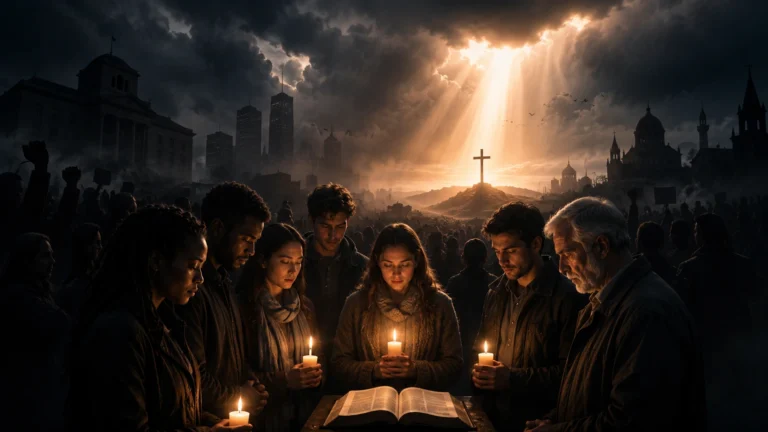
The violence directed toward Christians is real, but the subject deserves more precision than slogans usually allow. Christians are not the only religious people who face harassment, repression, or violence. They do, however, appear in the latest global data across an unusually broad range of countries, and in some regions believers face severe threats simply because they identify with Christ. The factual question is what the evidence actually shows. The Christian question goes deeper: why does allegiance to Jesus so often collide with systems, ideologies, and cultures that want the final word?
Those are different questions, and they should not be blurred. Global data can document harassment, restrictions, killings, arrests, intimidation, or property attacks. It cannot prove a theological explanation. This article will keep those layers distinct: first the evidence, then the Christian interpretation.
The distinction also protects us from an unChristian response. The enemy is not an ordinary Muslim, Jew, Hindu, Buddhist, atheist, Chinese citizen, Nigerian neighbor, Canadian official, progressive, conservative, or anyone else made in the image of God. Christians are called to tell the truth about persecution while refusing collective blame, hatred, and revenge.
That whole-person understanding of courage and spiritual identity connects with Your Muchness Is Body, Spirit, and Soul, which argues that human beings are more than bodies, labels, or social roles and must ultimately answer to God.
Table of Contents
What the Global Evidence Actually Shows
The strongest current global baseline comes from Pew Research Center’s 2026 analysis of religious restrictions in 2023. Pew found that religious groups experienced government or social harassment in 192 of 198 countries and territories. Christians were reported as harassed in 165 countries, Muslims in 143, Jews in 98, Hindus in 32, Buddhists in 22, and religiously unaffiliated people in 31.
That is significant, but Pew gives an important warning: a country is counted if even one qualifying incident is documented. The measure therefore shows geographic breadth, not severity. It cannot tell us which group endured the most intense persecution or the greatest number of victims.
The careful conclusion is this: Christians were reported as harassed in more countries than any other religious group in Pew’s 2023 dataset, but that statistic does not establish that Christians are the only victims or that every country presents the same level of danger.
| “Accuracy does not weaken the case for persecuted Christians. It makes the case harder to dismiss.” |
Nigeria: Severe Violence, Real Religious Targeting, and Real Complexity
Nigeria remains one of the clearest places where Christian communities face grave danger. USCIRF’s 2025 Nigeria Country Update describes ongoing, systematic religious-freedom violations, including extremist violence affecting both Christians and Muslims and government enforcement of blasphemy laws.
Pew’s global report also cites the December 2023 attacks in Plateau State that killed more than 150 people, mostly Christians, and displaced thousands. At the same time, the report notes competing local accounts involving land, resources, previous killings, and retaliation. That complexity should not be used to erase the Christian victims; neither should Christian suffering be used to pretend every Nigerian conflict has one cause.
Open Doors, a Christian persecution advocacy organization, describes Nigeria in its World Watch List 2026 documentation as a global epicenter of deadly violence against Christians, while also describing a mix of ethno-religious hostility, Islamic militancy, weak governance, and organized crime.
The Christian response should be morally serious and factually disciplined: pray for victims, support relief, call for equal protection under law, pressure governments to confront extremist violence, and refuse to turn an entire ethnicity or religion into the enemy.
China: When the State Demands the Highest Loyalty
China illustrates a different form of pressure. USCIRF’s 2025 China report states that religious-freedom conditions remained among the worst in the world and describes the Chinese Communist Party’s continuing ‘sinicization of religion’ policy, which requires recognized religious groups to subordinate themselves to the Party and its political agenda.
Christians are not the only targets. Uyghur Muslims, Tibetan Buddhists, Falun Gong practitioners, and other groups have also faced severe repression. That fact matters because the strongest argument is not that the Chinese state has singled out Christianity alone. The stronger argument is that authoritarian power becomes suspicious of any loyalty, institution, or conscience it cannot finally control.
Christianity creates precisely that kind of independent allegiance. To say ‘Jesus is Lord’ is spiritually basic for a Christian, but under a totalizing state it can also become politically significant. The confession places the state below God.
That principle connects naturally with Exercise Free Will: How to Not Become a Victim in This World, which argues that moral agency requires refusing to outsource conscience to institutions, ideology, appetite, or fear.
Canada: A Different Kind of Religious-Liberty Question
Western democracies are not Nigeria or China, and the comparison should never be flattened. In Canada, the relevant question is not violent persecution but the boundary between legitimate hate-crime protection and protection for peaceful religious expression.
A 2023 private member’s bill, Bill C-367, proposed removing the Criminal Code defence for good-faith opinions on religious subjects or opinions based on religious texts in prosecutions for wilful promotion of hatred or antisemitism. That bill did not advance beyond first reading in the 44th Parliament.
The issue later became real law through a different measure. Canada’s Combatting Hate Act (Bill C-9) received Royal Assent on June 18, 2026. The law created or strengthened protections against hate-motivated crime, intimidation or obstruction around places of worship and other protected spaces, and certain public displays of terrorist or Nazi symbols. It also repealed the former defence based on good-faith expression of opinions on religious subjects or texts for the relevant hate-propaganda offences.
That is more precise than saying ‘Canada declared the Bible hate speech,’ which would be false. The real religious-liberty concern is narrower: once a specific statutory defence for good-faith religious argument is removed, believers and legal scholars can reasonably ask how courts and prosecutors will distinguish protected religious teaching from unlawful promotion of hatred.
The deeper concern is not that quoting the Bible has suddenly become illegal. It is that removing the specific good-faith religious-text defense shifts more weight onto a contextual legal judgment about whether speech “willfully promotes hatred.” That standard is not limitless or arbitrary, but it does depend on how courts interpret wording, context, intent, audience, and surrounding circumstances. For pastors, teachers, writers, and ordinary believers, that can create a genuine chilling effect: even if a prosecution ultimately fails, the cost of investigation, legal defense, reputational damage, and public accusation can itself discourage lawful religious expression. The civil-liberties question, therefore, is whether the law protects people not only from conviction for protected speech, but also from being deterred from speaking in the first place.
Christians should defend both sides of the principle. People should be protected from threats, intimidation, violence, and genuine hate crimes. Peaceful religious teaching, preaching, debate, evangelism, and moral disagreement should also receive robust freedom. Religious liberty is strongest when Christians defend it consistently for everyone, not only for themselves.
| “Christians should ask for equal protection and equal freedom — not special privilege.” |
Why Christianity Can Provoke a Distinct Kind of Resistance
The evidence above tells us where harassment and legal pressure occur. It does not tell us why. The following explanation is theological: it is how Christianity understands conflict between allegiance to Christ and a fallen world.
Christianity does not present Jesus merely as a helpful teacher who can be added to an existing lifestyle. It proclaims Him as Lord, Savior, Judge, and the true light. That claim is inherently disruptive to any system — political, commercial, ideological, religious, or personal — that wants ultimate authority.
John’s Gospel describes Christ as the true light and says that people can resist light because it exposes what they want hidden. See John 1 and John 3. Within the Christian worldview, that provides a spiritual explanation for why truth can generate resistance rather than simple indifference.
A vague spirituality can often coexist with the prevailing culture because it asks little of anyone. Christianity makes harder claims: repent, forgive, submit pride, restrain appetite, love enemies, care for the vulnerable, tell the truth, honor God above every institution, and accept that human beings are not self-created sovereigns.
Those claims confront both public systems and private hearts. However, that does not prove that every criticism of Christianity is persecution. Christians can be hypocritical, cruel, partisan, or foolish if they are not truly in Christ.
| “Darkness does not merely ignore light. Within the Christian worldview, darkness resists light because light exposes what darkness wants to hide.” |
A Rival Kingdom Without a Rival Hatred
Christianity creates a rival allegiance, but it does not authorize rival hatred. A Christian belongs to Christ before party, nation, employer, social class, ideology, or tribe. That limits the claims those systems can make over conscience.
Ephesians 6:11-12 frames the deepest struggle as spiritual rather than a fight against ‘flesh and blood.’ Read the passage. That teaching should make Christians less likely to demonize ordinary people, not more likely.
The Muslim neighbor is not the enemy. The atheist coworker is not the enemy. The Chinese citizen is not the CCP. The Nigerian herder is not automatically an extremist. The Canadian legislator is not automatically hostile to Christianity. Precision is part of Christian truthfulness.
For a broader framework on separating ideas from people and examining the worldview underneath cultural pressure, see Philosophy in Everyday Life: How You Think Determines How Successful You Will Be.
What About Double Standards?
Many Christians perceive that Christianity is sometimes mocked, caricatured, or restricted in settings where institutions would treat other faiths more cautiously. That can happen. But a responsible argument should identify the specific institution, rule, statement, or case rather than turning a perception into a universal claim.
A principled religious-freedom position is stronger than a tribal one. Christians should oppose antisemitism, anti-Muslim violence, attacks on churches, restrictions on peaceful atheists, and persecution of any peaceful religious community. The same legal and cultural standards should apply to Christian teaching.
The correct dividing line is not ‘speech I agree with’ versus ‘speech I dislike.’ A free society must distinguish peaceful disagreement from threats, intimidation, targeted harassment, and incitement. Those distinctions can be difficult in practice, which is exactly why precise law and careful judicial interpretation matter.
How Christians Should Respond
If Christians face hostility, the New Testament response is not revenge. Jesus warned His followers that faithfulness could bring persecution, but He also commanded love of enemies and prayer for persecutors.
That creates a demanding posture: gentler toward people and stronger toward deception; less reactive in tone and more durable in conviction; unwilling to lie about persecution, but equally unwilling to exaggerate it.
Practical faithfulness can include supporting organizations that aid persecuted believers, contacting elected representatives about religious-freedom abuses, helping refugees, praying for specific churches and regions, giving to credible relief efforts, and learning enough about a conflict to avoid repeating slogans.
For readers who want to think more deeply about how reason, worldview, worship, and spiritual authority fit together, The Difference Between Philosophy and Religion provides the deeper Standard Member companion.
A Practical Discernment Table
| Question | Why It Matters | Christian Response |
| Who is acting? | Government, extremist group, mob, institution, company, or individual are not interchangeable. | Name the actor precisely; do not condemn whole populations. |
| What is the evidence? | Viral claims can be true, incomplete, exaggerated, or false. | Check dates, original legal text, source methodology, and context. |
| What does the statistic measure? | Country counts, incident counts, casualties, and severity are different metrics. | Do not use one metric to claim what it cannot prove. |
| Is this disagreement or coercion? | Moral disagreement is not the same as threats, violence, or incitement. | Defend peaceful speech while opposing actual intimidation and violence. |
| Are other victims being acknowledged? | Selective empathy damages credibility and Christian witness. | Ask for equal protection for Christians and all peaceful communities. |
| What spiritual fruit is present? | Fear and rage can make even a true concern spiritually destructive. | Pursue truth, courage, prayer, self-control, and love. |
The Bottom Line: The Light Is Still the Answer
The strongest case for persecuted Christians does not need exaggeration. Christians are harassed across a remarkably broad range of countries. In some places, believers face deadly violence. In others, authoritarian governments subordinate churches to the state. In democratic societies, religious-liberty debates increasingly turn on how law distinguishes protected conviction from unlawful hatred.
The Christian interpretation goes deeper than those political and legal layers: Christ is light, and a fallen world often resists light. But that belief never gives Christians permission to hate the people around them.
Do not become bitter. Become clear. Do not become reckless. Become accurate. Do not become afraid. Become faithful. Defend religious freedom, pray for the persecuted, speak truthfully, love your enemies, and keep the light burning where God has placed you.
Closing CTA
Choose one concrete response this week: learn the facts about one persecuted Christian community, pray for it by name, support a credible relief or religious-freedom organization, or strengthen your own ability to explain and defend religious liberty without hatred. Courage begins with truth, and Christian courage must remain joined to love.
Source and Fact-Checking Notes
- Pew Research Center — Harassment of religious groups around the world in 2023 — Provides the 2023 country-count data: religious groups harassed in 192 of 198 countries; Christians in 165; Muslims in 143; Jews in 98. Pew explicitly cautions that this measure does not rank severity or identify a ‘most persecuted’ religion. Source
- USCIRF — Nigeria Country Update, July 2025 — Supports the discussion of ongoing systematic religious-freedom violations, extremist violence affecting Christians and Muslims, and blasphemy-law enforcement. Source
- Open Doors — World Watch List 2026 Documentation — Christian advocacy source describing Nigeria as a global epicenter of deadly violence against Christians while also noting ethno-religious hostility, militancy, weak governance, and organized crime. Source
- USCIRF — China 2025 Annual Report — Supports the discussion of severe religious-freedom restrictions, sinicization policy, CCP control, and repression affecting multiple faith communities. Source
- Parliament of Canada — Bill C-367, 44th Parliament — Confirms that the 2023 private member’s bill proposed repealing the good-faith religious-subject/text defence and did not advance beyond first reading. Source
- Justice Canada — Combatting Hate Act / Bill C-9 — Confirms Royal Assent on June 18, 2026; protections around places of worship and hate-motivated offences; and repeal of the former religious-subject/text defence. Source
- Bible Gateway — John 1 and John 3 — Supports the article’s Christian theological framing of Christ as light and human resistance to light. Source
- Bible Gateway — Ephesians 6:11-12 — Supports the spiritual-conflict framing while explicitly directing Christians away from treating flesh-and-blood people as the ultimate enemy. Source
Sources and Further Reading
- Pew Research Center — Religious Restrictions Around the World — Read
- USCIRF — 2025 Annual Report and Country Materials — Read
- Justice Canada — Combatting Hate Act Backgrounder — Read
- Parliament of Canada — Bill C-367 Legislative Record — Read
- Open Doors — World Watch List Research Documentation — Read
Disclosure
This article is written from a Christian worldview and combines documented facts about religious harassment and law with Christian theological interpretation. The theological explanation — including the language of light, darkness, sin, spiritual conflict, and allegiance to Christ — is a statement of Christian belief rather than an empirical finding. The article does not claim that Christians are the only persecuted religious group, that all hostility toward Christians is persecution, or that ordinary people of any religion, nationality, or political viewpoint should be blamed for the actions of governments, extremists, institutions, or individuals. Legal discussion is educational, not legal advice.
