


How to think clearly has become a practical survival skill because modern information systems are built for reaction. The fastest headline wins attention. The angriest interpretation earns engagement. The newest claim feels urgent before anyone has checked whether it is true. If you do not deliberately control that process, someone else — an algorithm, a tribe, a commentator, an advertiser, or your own emotions — will often control it for you.
That is the cost of noise: it does not merely give you bad information. It trains you to make judgments at the wrong speed.
Research gives us a reason to take that problem seriously. A large 2018 Science study of roughly 126,000 verified news stories shared by about three million Twitter users found that false stories spread farther, faster, deeper, and more broadly than true ones. The researchers also found that novelty and human sharing behavior — not simply bots — helped drive the difference.
The practical response is not to distrust everything. It is to build a disciplined filter. That fits the broader Christian-worldview framework developed in The Difference Between Philosophy and Religion: philosophy trains us to ask what is true and how we know, while a Christian worldview adds a moral obligation to love truth rather than merely use information.
| “Noise wins when it controls your speed. Truth gains ground when you control your attention.” |
Table of Contents
Why Reaction Is Such a Powerful Trap
Reaction feels productive because it is immediate. You see a headline, feel anger or fear, form a conclusion, and share it. The brain receives the satisfaction of having taken a position before the evidence has even been fully processed.
Social platforms can reinforce that pattern because engagement itself becomes a reward. Research in Nature Communications analyzing more than one million posts found that social-media behavior followed patterns consistent with reward learning: users adjusted behavior in response to social rewards such as positive engagement.
The deeper problem is not technology alone. Human beings have always been vulnerable to rumor, group pressure, pride, fear, selective attention, and confirmation bias. Technology simply increases the speed, scale, and frequency at which those tendencies can operate.
Pew Research Center has also found that many people who regularly get news through major social platforms sometimes or often feel worn out by the amount of news they encounter. That matters because fatigue does not usually make reasoning better. It makes shortcuts more attractive.
1. Slow the Reaction Before You Judge the Claim
The first discipline is simple: do not let the speed of the feed become the speed of your judgment.
When something produces immediate anger, fear, vindication, or excitement, that is the moment to slow down — not because the claim must be false, but because emotional intensity makes immediate certainty especially attractive.
You do not have to investigate everything. Sometimes the correct decision is simply not to react yet.
| Reaction Mode | Clear-Thinking Mode |
| I need to respond now. | I need to know whether this is true first. |
| Everyone is talking about it. | What evidence exists beyond repetition? |
| This confirms what I suspected. | What would challenge my conclusion? |
| The headline sounds decisive. | What does the underlying source actually say? |
| Silence feels passive. | Waiting can be an active decision when evidence is incomplete. |
James gives a remarkably practical principle: be quick to listen, slow to speak, and slow to become angry. See James 1:19–20 (NIV). That is not a command to become passive. It is a command to govern the sequence.
2. Separate What Is Known From What Is Being Inferred
Many weak arguments hide their uncertainty by mixing three categories together: fact, inference, and speculation.
A company missed earnings. That is a fact. Management is hiding a larger problem. That may be an inference. The company will fail within a year. That is a prediction.
The same pattern appears in health, politics, relationships, theology, and everyday life. Once the categories blur, an interpretation begins to feel as certain as the evidence underneath it.
| Category | Question to Ask | Example |
| Known fact | What can be directly verified? | A report was published; a quote was recorded; a measured value changed. |
| Inference | What interpretation best explains the facts? | The change may reflect weakening demand. |
| Unknown | What information is still missing? | We do not yet know whether the change is temporary or structural. |
| Prediction | What future outcome is being projected? | If the trend continues, risk may rise. |
| Opinion / value judgment | What standard is being applied? | The policy is wise, unjust, excessive, prudent, etc. |
This one habit can improve judgment dramatically because it forces uncertainty into the open.
3. Ask the Question Most People Avoid: What Would Prove Me Wrong?
The easiest information to accept is information that confirms what we already believe.
That is why serious thinking requires a deliberate search for disconfirming evidence. Before accepting a claim, ask: What evidence would change my mind? What fact would weaken this interpretation? Who makes the strongest credible case on the other side?
If the answer is ‘nothing could change my mind,’ you are no longer evaluating the claim. You are protecting an identity.
| “A belief that cannot survive a serious question is not strengthened by avoiding the question.” |
4. Trace Important Claims Back to the Original Source
A screenshot of a headline is not a source. A clipped video is not the full interview. A viral chart without methodology is not analysis. A commentator describing a study is not the study.
For claims that matter, move upstream.
- Find the original study, court filing, earnings report, speech, transcript, dataset, government release, or full interview.
- Check the date. Old facts are often recirculated as current facts.
- Read beyond the headline or highlighted sentence.
- Look for sample size, denominator, comparison group, methodology, and limitations where relevant.
- Ask whether the summary you saw accurately represents what the source actually concluded.
The farther a claim travels from the original source, the more opportunities exist for context to disappear.
5. Put Accuracy Ahead of Sharing
One of the most useful findings in misinformation research is surprisingly hopeful: people often do care about accuracy, but accuracy is not always what their attention is focused on when they decide to share.
A 2022 Nature Communications meta-analysis covering 20 experiments and 26,863 participants found that simple prompts directing attention toward accuracy improved the quality of what people intended to share. In those experiments, sharing intentions for false headlines fell by about 10% relative to control.
That suggests a practical habit anyone can use: before forwarding something, ask one explicit question — ‘Do I actually believe this is accurate?’
The question sounds almost too simple. That is precisely why it works as a discipline. It moves attention away from novelty, identity, humor, outrage, or usefulness to your side — and back toward truth.
6. Examine the Incentives Behind the Message
Information does not arrive without incentives. News organizations need attention. Politicians need support. Companies need customers. Influencers need engagement. Activists need action. Researchers need publication. You and I may want confirmation, belonging, status, or the satisfaction of being first.
An incentive does not make a claim false. But understanding the incentive helps you decide where extra scrutiny belongs.
| Question | Why It Matters |
| Who benefits if I believe this? | Reveals commercial, political, reputational, or social incentives. |
| What does the messenger want me to do next? | Separates information from persuasion. |
| What evidence would the messenger prefer I not examine? | Identifies possible blind spots or selective presentation. |
| Is urgency essential to the facts — or essential to getting my reaction? | Distinguishes real deadlines from manufactured pressure. |
| Would the claim still persuade me if it came from someone outside my group? | Tests tribal / identity bias. |
The mature response is not ‘everyone has an agenda, therefore nothing is true.’ That is cynicism. The mature response is: incentives are one variable in evaluating evidence, not a substitute for evidence.
7. Anchor Your Mind Before the Crowd Anchors It for You
Clear thinking is not merely an intellectual skill. It is also a formation problem.
What you repeatedly attend to trains what you notice. What you repeatedly react to trains your emotional defaults. What you repeatedly believe without testing trains your standards of evidence.
Romans 12 tells Christians not to be conformed to the pattern of the world but to be transformed by the renewing of the mind. See Romans 12:2 (NIV). The verse is spiritual, but it has an obvious intellectual implication: Christians are not called to outsource judgment to the prevailing pattern.
Scripture repeatedly joins truth with testing. 1 Thessalonians 5:21 (NIV) says to test everything and hold on to what is good. Proverbs 18:13 (NIV) warns against answering before listening. Philippians 4:8 (NIV) directs attention toward what is true, noble, right, pure, lovely, and admirable.
That gives Christian discernment a demanding standard: not ‘Does this help my side?’ but ‘Is it true, and am I handling it truthfully?’
That principle connects directly with Philosophy in Everyday Life: How You Think Determines How Successful You Will Be: how you think becomes how you decide, and how you repeatedly decide becomes part of who you become.
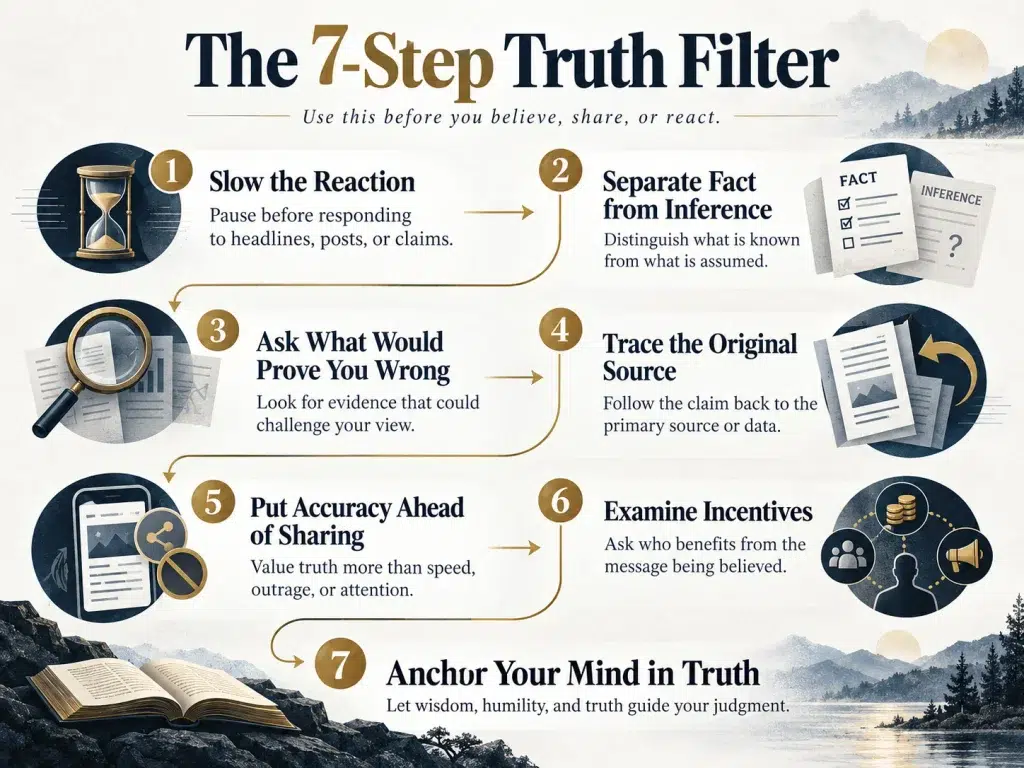
The 7-Step Truth Filter
| Step | Question | Decision Rule |
| 1. Slow | Am I reacting faster than the evidence warrants? | Delay judgment if emotion is outrunning verification. |
| 2. Separate | What is fact, inference, unknown, prediction, or opinion? | Do not give each category the same confidence. |
| 3. Challenge | What would prove me wrong? | Actively seek credible disconfirming evidence. |
| 4. Trace | What is the original source? | Move upstream before repeating an important claim. |
| 5. Verify | Do I actually believe this is accurate? | Put accuracy ahead of sharing or signaling. |
| 6. Inspect | What incentives shape the message? | Add scrutiny without assuming motive proves falsity. |
| 7. Anchor | What standard governs my mind? | Choose truth, Scripture, humility, and disciplined attention over crowd reaction. |
What Clear Thinking Does Not Mean
- It does not mean never having strong convictions.
- It does not mean treating every claim as equally uncertain.
- It does not mean pretending truth is always somewhere in the middle.
- It does not mean distrusting every institution or expert.
- It does not mean trusting institutions or experts without examining evidence.
- It does not mean becoming so cautious that you never make a decision.
- It does mean calibrating confidence to evidence — and changing your mind when better evidence requires it.
The Competitive Advantage of a Calm Mind
A reactive culture creates an advantage for anyone who can remain calm without becoming passive.
In investing, that may mean refusing to chase a headline before price and evidence confirm the story. In health, it may mean reading the actual study before adopting or rejecting a treatment. In relationships, it may mean asking a question before assigning motive. In politics, it may mean reading the bill, ruling, transcript, or data before repeating the commentary. In faith, it may mean testing a popular teaching against Scripture rather than against popularity.
Clear thinking does not guarantee that you will always be right. It does something more realistic and more valuable: it improves the process by which you can discover when you are wrong.
| “The goal is not to react faster than everyone else. It is to understand enough that your next action deserves your confidence.” |
Conclusion: Truth Requires a Different Pace
The modern information environment rewards speed. Truth often requires a different pace.
Slow the reaction. Separate facts from interpretations. Ask what would prove you wrong. Trace claims to original evidence. Put accuracy ahead of sharing. Examine incentives. Anchor your mind in a standard higher than the crowd.
These disciplines will not remove noise from the world. They will make the noise less capable of controlling you.
That is the real meaning of truth over noise: not knowing everything, but refusing to let urgency, outrage, novelty, or belonging decide what you believe before the evidence has earned it.
Source and Fact-Checking Notes
- Science / PubMed — The Spread of True and False News Online — 2018 study of ~126,000 stories shared by ~3 million people on Twitter from 2006–2017; falsehood spread farther, faster, deeper, and more broadly than truth. Findings are platform/time-specific and should not be generalized mechanically to all media. Source
- MIT Sloan — False News Spreads Faster Than Truth — Accessible summary of the Science findings, including 70% greater retweet likelihood and much faster diffusion to 1,500 people. Source
- Nature — Shifting Attention to Accuracy Can Reduce Misinformation Online — Experiments and a Twitter field test support the idea that people often share low-quality information because attention is focused on factors other than accuracy. Source
- Nature Communications — Accuracy Prompts Meta-Analysis — 20 experiments / 26,863 participants; accuracy prompts improved sharing discernment and reduced sharing intentions for false headlines by ~10% relative to control. Source
- Nature Communications — Computational Reward Learning and Social Media Engagement — Analysis of >1 million posts from >4,000 users found social-media behavior consistent with reward-learning dynamics; useful for incentive context, not proof of deliberate manipulation in every case. Source
- Pew Research Center — How Americans Get News on Social Platforms — 2024 survey context: many regular news consumers on Facebook, X, and Instagram report feeling worn out by the news at least sometimes. Source
- Bible Gateway — James 1:19–20 (NIV) — Biblical grounding for listening before speaking and governing anger. Source
- Bible Gateway — Romans 12:2 (NIV) — Biblical grounding for resisting conformity and renewing the mind. Source
- Bible Gateway — 1 Thessalonians 5:21 (NIV) — Biblical instruction to test everything and hold fast to what is good. Source
Sources and Further Reading
- Science / PubMed — The Spread of True and False News Online — Read
- Nature — Shifting Attention to Accuracy Can Reduce Misinformation Online — Read
- Nature Communications — Accuracy Prompts Meta-Analysis — Read
- Nature Communications — Social Media Reward Learning — Read
- Pew Research Center — Social Media and News Consumption — Read
Closing CTA
Use the 7-Step Truth Filter the next time a headline, clip, statistic, or post produces an immediate emotional reaction. Do not begin with ‘Do I agree?’ Begin with ‘What is actually known?’ Then move deliberately through the evidence before you believe, share, or act. Clear thinking becomes a habit the same way reaction does — one repeated decision at a time.
Disclosure
This article is written from a Christian worldview and is intended to develop practical reasoning and discernment. It does not claim that Christians, experts, institutions, journalists, or independent thinkers are immune to bias or error. The goal is not indiscriminate skepticism but disciplined confidence calibrated to evidence, context, and truth.
