

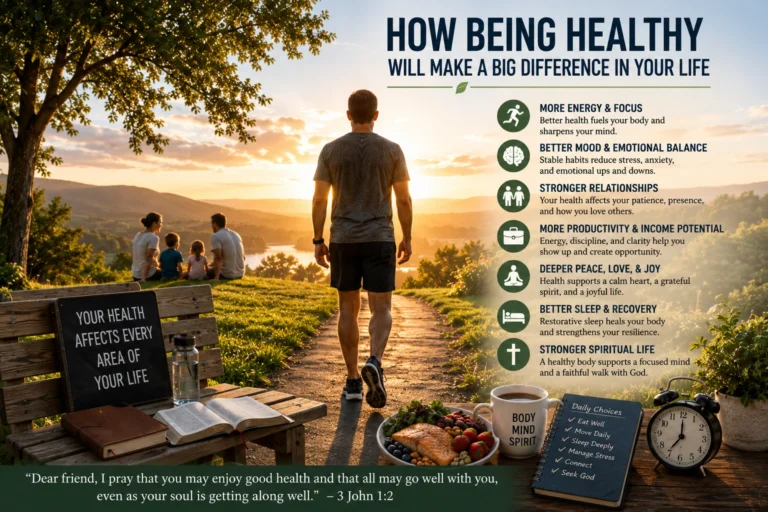
This article provides general health education from a whole-person wellness perspective. It is not medical advice and should not replace care from a qualified clinician, especially for readers with chronic illness, injury, pregnancy, disability, or medication concerns. The goal is to encourage practical stewardship of physical, mental, emotional, relational, and spiritual health to receive the full benefits of being healthy.
Being healthy changes more than how you look in the mirror. It changes how you wake up, how you think, how you handle pressure, how you treat the people around you, and how much life you are able to carry without breaking down.
Health is not a trophy for the young, the athletic, or the genetically blessed. It is stewardship. It is the daily work of caring for the body, mind, emotions, relationships, and spirit God has given you. No one has perfect health, and many people carry burdens they did not choose. Still, almost everyone has some room to improve the foundation underneath daily life.
That foundation matters. A body running on poor sleep, processed food, stress, and inactivity will usually produce a different life than a body supported by rest, real food, movement, peace, and purpose. A tired mind makes poorer decisions. A restless soul reacts faster. A neglected body eventually sends invoices.
What Does It Mean to Be Healthy introduced health as a whole-person issue: physical, mental, emotional, and spiritual. This article goes one step further. It asks what changes when health begins to improve.
Table of Contents
Health Gives You More Energy for Ordinary Life
Most people do not need a dramatic health transformation to notice the first benefit. They need enough energy to live the day without dragging themselves through it.
Energy changes the texture of life. A healthier person is more likely to get out of bed with a little readiness instead of immediate dread. Work feels less like survival. Chores become less overwhelming. Conversations require less emotional effort. Even small pleasures – a walk, a meal with family, a quiet evening – become easier to enjoy.
This is why diet, sleep, and exercise are not side hobbies. They are energy systems. Food provides raw material. Sleep repairs and resets. Movement keeps the body capable. When those three are neglected, life shrinks. When they improve, life usually opens back up.
Health Improves Mental Clarity and Decision-Making
A foggy brain can make a manageable problem feel impossible. Poor sleep, chronic stress, dehydration, blood sugar swings, too much alcohol, inactivity, and ultra-processed food can all make the mind less steady.
Good health does not make every decision easy. But it can make you harder to confuse and easier to focus. You think more clearly when your body is not constantly fighting exhaustion. You plan better when your nervous system is not running hot. You listen better when you are not mentally overloaded.
That matters because life is largely built from decisions. What you eat. Whether you move. How you spend money. How you respond to criticism. Whether you pray before reacting. Whether you speak sharply or pause. Health gives your better judgment more room to operate.
Health Can Improve Your Work and Income Potential
This point should be made carefully. Health does not guarantee income. Many healthy people struggle financially, and many people with serious health burdens work with courage and excellence. But as a general principle, a healthier body and mind can strengthen the traits that often support better work.
Energy, focus, emotional steadiness, endurance, reliability, and resilience all matter in the workplace. A person who sleeps better may think better. A person who exercises may handle stress better. A person who eats real food may avoid the afternoon crash that turns work into a blur. A person with more peace may be less likely to sabotage relationships with coworkers, customers, or supervisors.
Over time, those things can matter. They may help a person learn faster, show up more consistently, communicate more wisely, and carry responsibility with less resentment. That does not mean health is a magic income formula. It means health is part of capacity. Capacity influences opportunity.
How to Prevent Commercial Interests from Stealing Your Health explains how modern food, medication, and consumer systems can quietly weaken that capacity if a person is not paying attention.
Health Strengthens Relationships
Relationships often suffer when people are depleted. A person who is exhausted, inflamed, anxious, over-caffeinated, under-slept, and spiritually dry will have a harder time being patient. The body keeps score, and eventually the family hears the score.
Healthier relationships require more than nutrition and exercise, of course. They require repentance, forgiveness, honesty, humility, and love. But physical and mental health can make those virtues easier to practice. It is harder to listen well when you are chronically tired. It is harder to apologize when your nervous system is always on edge. It is harder to be kind when your body feels like an emergency.
A healthier person often has more emotional margin. Not perfect calm. Not constant sweetness. Just more space between stimulus and response. That small space can save a marriage conversation, soften a parenting moment, or keep a friendship from becoming another casualty of stress.
Health Supports Emotional Balance
Emotional health is not the absence of strong feeling. It is the ability to feel honestly without being ruled by every feeling. A healthy person can grieve without despairing, disagree without exploding, and face pressure without immediately looking for escape.
This is one reason peace, love, joy, and rest belong in a serious discussion of health. They are not decorative words. They are signs of inner order. A life with no peace will eventually become unhealthy, even if the diet looks clean. A life with no love becomes cold. A life with no joy becomes brittle. A life with no rest becomes unsustainable.
Christian health should therefore include the heart. A person may have good lab numbers and still be spiritually frantic. Another may have physical limitations but possess a deep steadiness in Christ. The goal is not to pretend the body does not matter. The goal is to refuse a shallow definition of health that ignores the soul.
The Positive Impact Christian Spirituality Will Have in Your Life connects this inner life to Christian hope, peace, and eternal perspective.
Diet: Your Body Needs Better Building Material
Food is not merely fuel. It is information and building material. The body uses what it receives to repair tissue, regulate hormones, support immunity, make neurotransmitters, stabilize energy, and maintain strength.
A healthier diet does not need to be complicated. Most people benefit from moving toward real food: meat, eggs, fish, vegetables, fruit, beans where tolerated, nuts, properly prepared grains if used, clean fats, and meals cooked from recognizable ingredients. The more a food looks like something a great-grandparent would recognize, the better the odds that it belongs in a sane diet.
That does not mean every meal must be perfect. Perfection usually fails. Direction matters more. Replace the daily processed snack with real food. Replace sugar drinks with water. Replace the drive-through habit with a few simple meals cooked at home. Over months, small choices become a different body.
Sleep: The Repair System Many People Treat as Optional
Sleep is often the first health habit sacrificed and the last one respected. That is backwards.
The CDC notes that enough sleep supports immune function, healthy weight, stress reduction, mood, heart health, metabolism, attention, and memory. Most adults need at least seven hours per night. That is not laziness. It is maintenance.
A tired person may still function, but functioning is not the same as thriving. Chronic sleep loss can make people more reactive, more hungry, less focused, and less resilient. It can turn a decent day into a grind before breakfast.
Better sleep often begins with ordinary discipline: a consistent bedtime, morning sunlight, less late caffeine, fewer screens at night, a cooler room, and a willingness to stop treating exhaustion as a badge of honor.
Exercise: Strength Changes How Life Feels
Exercise is not only about weight loss. In many ways, weight loss is the least interesting benefit. Movement improves cardiovascular fitness, muscle, balance, insulin sensitivity, mood, sleep, and confidence. It also teaches the body that effort is survivable.
The CDC summarizes the adult guideline as 150 minutes of moderate-intensity physical activity per week, plus two days of muscle-strengthening activity. That can sound intimidating, but it does not have to begin there. Start with a walk. Add a few pushups against a counter. Carry groceries intentionally. Take stairs. Build momentum.
A stronger body changes your relationship to the world. Stairs are less threatening. Yard work is less punishing. Travel is easier. Emergencies are less frightening. Aging still comes, but strength gives you more room to meet it with dignity.
Spiritual Health: Peace Is Not a Luxury
No health plan is complete if the soul remains neglected. Human beings were not designed to live by calories, steps, sleep scores, and bloodwork alone.
Spiritual health begins with orientation. Who is God? Who am I before him? What is my life for? What do I do with guilt, fear, death, suffering, and the need to be loved? Christianity answers those questions not with a wellness slogan, but with Jesus Christ.
A life rooted in Christ can develop a kind of peace that is not dependent on perfect circumstances. That peace does not eliminate pain. It steadies the person inside pain. It helps love survive disappointment. It helps joy return after sorrow. It teaches rest in a world that profits from anxiety.
How to Build a Daily Christian Spiritual Practice offers a practical structure for prayer, Scripture, worship, reflection, service, and accountability.
Health Helps You Serve, Not Merely Succeed
The best reason to become healthier is not vanity. It is service.
A healthier person can often give more generously: more attention to a spouse, more patience to a child, more steadiness at work, more availability to a neighbor, more discipline in calling, more courage under pressure. Health is not the point of life, but it can support the point of life.
This matters because modern health culture often becomes self-focused. The body becomes a project. The image becomes the goal. The mirror becomes the judge. Christian health should move in the opposite direction. Care for the body so you can love God and neighbor more faithfully. Strength is stewardship. Peace is stewardship. Rest is stewardship.
A Simple Whole-Life Health Scorecard
If you want to know whether health is improving, do not look only at the scale. Ask better questions.
Do I have more energy during the day? Am I sleeping more consistently? Is my mind clearer? Am I less reactive? Do I recover from stress faster? Am I eating more real food? Am I moving my body regularly? Are my closest relationships receiving a better version of me? Do I have more peace with God? Is there more love, joy, and rest in my life?
Those questions are harder to fake. They also point to the real goal: a life that is stronger, steadier, more loving, and more available to God.
Conclusion: Health Is a Life Multiplier
Being healthy will not solve every problem. It will not remove suffering, guarantee wealth, prevent all disease, or make relationships effortless. Anyone who promises that is selling something.
But health can make a big difference. It can give you more energy, clearer thinking, better emotional control, stronger work capacity, deeper relationships, and greater resilience. It can help you enjoy what is good, endure what is hard, and serve more faithfully.
The body matters. The mind matters. The emotions matter. The soul matters. Diet, sleep, exercise, peace, love, joy, and rest are not separate compartments. They work together. When they are neglected, life narrows. When they are cultivated, life opens.
That is why health is not selfish. Properly understood, it is preparation for love.
Closing CTA Regarding the Benefits of Being Healthy
Choose one area of health to improve this week: sleep, food, movement, emotional steadiness, or spiritual rest. Do not try to rebuild your entire life in one day. Begin with one faithful step, then let that step become part of a stronger pattern.
Source and Fact-Checking Notes
The following sources were used to support key claims, provide background context, and help readers examine the topic more deeply. This article is educational and should not replace guidance from a qualified healthcare professional.
- World Health Organization – Health and Well-Being – https://www.who.int/data/gho/data/major-themes/health-and-well-being – WHO constitution definition of health as physical, mental, and social well-being, not merely absence of disease.
- CDC – About Mental Health – https://www.cdc.gov/mental-health/about/index.html – Explains that mental and physical health are closely linked and both matter to overall health.
- CDC – About Sleep – https://www.cdc.gov/sleep/about/index.html – Summarizes health benefits of sleep, including mood, stress, heart health, metabolism, attention, and memory.
- CDC – How Much Sleep Do I Need? – https://www.cdc.gov/sleep/about/index.html – CDC sleep education hub noting adult sleep needs and benefits.
- CDC – Adult Physical Activity Guidelines – https://www.cdc.gov/physical-activity-basics/guidelines/adults.html – States adult guideline of 150 minutes moderate activity weekly plus 2 days of muscle strengthening.
- U.S. Department of Health and Human Services – Physical Activity Guidelines for Americans – https://health.gov/our-work/nutrition-physical-activity/physical-activity-guidelines – Primary U.S. guidance on physical activity for health.
- CDC – Benefits of Physical Activity – https://www.cdc.gov/physical-activity-basics/benefits/index.html – Overview of physical activity benefits for brain health, heart health, weight, and disease risk.
- NIH / National Heart, Lung, and Blood Institute – Sleep Deprivation and Deficiency – https://www.nhlbi.nih.gov/health/sleep-deprivation – Explains how sleep deficiency affects health, performance, and safety.
- Harvard T.H. Chan School of Public Health – The Nutrition Source: Healthy Eating Plate – https://www.hsph.harvard.edu/nutritionsource/healthy-eating-plate/ – General evidence-based framework for healthy eating patterns.
- Blue Zones – Power 9 Lifestyle Habits – https://www.bluezones.com/2016/11/power-9/ – Popular summary of lifestyle patterns observed in long-lived populations; useful as a non-clinical comparison source.
- PubMed Central – Religion, Spirituality, and Health: The Research and Clinical Implications – https://pmc.ncbi.nlm.nih.gov/articles/PMC3671693/ – Review discussing associations between religion/spirituality and health outcomes.
- Pew Research Center – Religion’s Relationship to Happiness, Civic Engagement and Health Around the World – https://www.pewresearch.org/religion/2019/01/31/religions-relationship-to-happiness-civic-engagement-and-health-around-the-world/ – Cross-national evidence on religious participation, happiness, civic engagement, and health-related outcomes.
- Bible Gateway – Galatians 5:22-23 – https://www.biblegateway.com/passage/?search=Galatians%205%3A22-23&version=NIV – Biblical source for love, joy, peace, and other fruit of the Spirit.
- Bible Gateway – Matthew 22:37-40 – https://www.biblegateway.com/passage/?search=Matthew%2022%3A37-40&version=NIV – Jesus’ command to love God and neighbor; supports health as preparation for love and service.
- Bible Gateway – 1 Corinthians 6:19-20 – https://www.biblegateway.com/passage/?search=1%20Corinthians%206%3A19-20&version=NIV – Biblical basis for viewing the body as stewardship before God.
- Bible Gateway – Matthew 11:28-30 – https://www.biblegateway.com/passage/?search=Matthew%2011%3A28-30&version=NIV – Jesus’ invitation to rest; supports the spiritual-health section.
