


The historical case for Jesus begins with a striking fact: Christianity does not ask us to believe in a savior who lived in an undefined mythic age. Jesus of Nazareth appears in the first-century world of Herod, Tiberius, Pontius Pilate, Caiaphas, Jerusalem, Galilee, Passover, Roman crucifixion, Jewish Scripture, and named followers who proclaimed within their own lifetimes that the man they had seen die was alive again.
History cannot place the Son of God in a laboratory. It can, however, ask whether Jesus existed, what the earliest sources say He did and claimed, whether the documents were transmitted reliably, whether outside witnesses corroborate key parts of the story, whether archaeology fits the world the Gospels describe, how early the resurrection proclamation appears, and which explanation best accounts for the rise of the Christian movement.
For Christians, the final claim is larger than history alone: Jesus is not merely a first-century teacher. He is the Word made flesh, the promised Messiah, the Son of God, the crucified Savior, the risen Lord, and the One through whom sinful human beings are reconciled to God. But that theological confession is anchored to claims about real events. If Jesus did not live, die, and rise, Christianity collapses. That makes Christianity unusually open to historical investigation.
Table of Contents
Jesus the Man: What History Can Establish
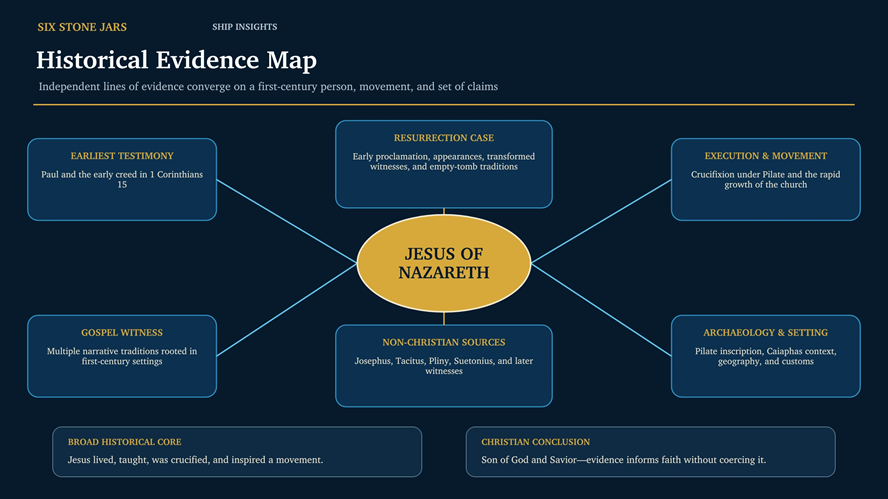
Across a wide range of historical scholarship, several basic points are not seriously disputed: Jesus was a first-century Jew from Galilee; He was associated with John the Baptist; He taught publicly and gathered followers; He became the center of controversy; and He was crucified under the Roman prefect Pontius Pilate during the reign of Tiberius. The debate begins not with whether Jesus existed, but with what to make of Him.
The Gospels place Jesus in a network of identifiable people, places, customs, and political realities. That does not automatically prove every narrated event. It does mean the story presents itself as history rather than timeless myth. Archaeology and non-Christian sources repeatedly intersect that world: Pontius Pilate is independently attested, Caiaphas belongs to the correct priestly period, first-century Jerusalem sites match Gospel geography, and hostile Roman writers knew a movement named for a crucified Christus.
Jesus the Son of God: What Did He Claim?
Jesus did not usually walk through Galilee reciting a modern doctrinal formula such as, “I am the second person of the Trinity.” His identity emerges through the titles He accepted, the authority He exercised, the actions He performed, and the way He placed Himself within Israel’s story.
He announced the kingdom of God, forgave sins, claimed authority over the Sabbath, spoke as the decisive interpreter of God’s will, accepted messianic titles, repeatedly called Himself the Son of Man, spoke of a unique relationship with the Father, and in the Gospel of John used language that Christians understood as placing Him within the identity of Israel’s God. His enemies did not always misunderstand Him: some controversies in the Gospel narratives turn precisely on the magnitude of His claims.
The Christian case is therefore cumulative. Read Mark 2, Mark 14:61–64, John 8:48–59, and John 10:22–39 together, and the question is not merely whether Jesus was spiritual. It is whether He understood His identity and mission in categories that forced His hearers to decide what to do with Him.
Jesus the Savior: What Did He Do for Us?
The heart of Christianity is not simply that Jesus taught better morals. The New Testament says humanity’s deepest problem is alienation from God through sin and death. Jesus came to do what human beings cannot do for themselves: reveal the Father, bear sin, defeat death, reconcile sinners to God, and inaugurate the kingdom that will ultimately make all things new.
The cross therefore carries several biblical dimensions at once. It is sacrifice, substitution, ransom, victory, reconciliation, covenant, judgment, and love. Christians confess that Jesus willingly gave His life, not as an accidental victim of history, but as the Lamb of God and the mediator between God and humanity. The resurrection is God’s vindication of Jesus and the foundation of Christian hope: death is not the final word.
Key passages include Isaiah 52:13–53:12, Mark 10:45, Romans 3:21–26, and 1 Corinthians 15.
| “Christianity rises or falls on a public claim: the crucified Jesus was proclaimed alive again by the people who said they knew Him.” |
When Was Jesus Born?
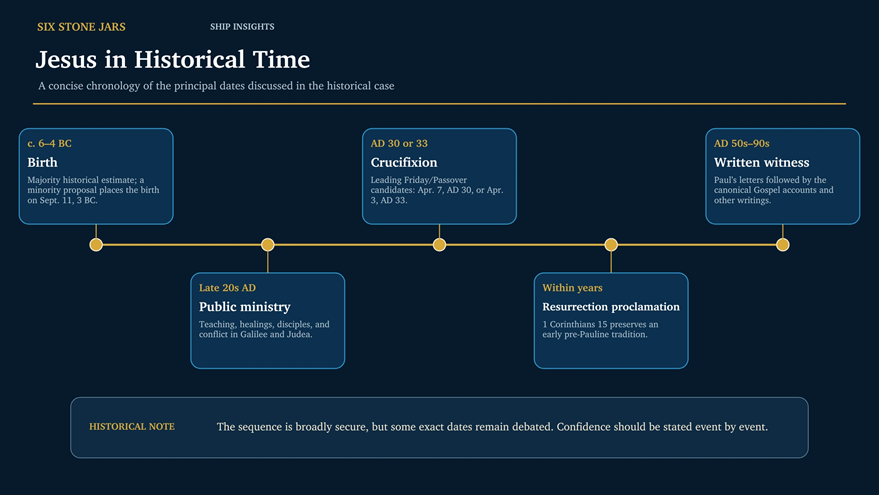
The New Testament does not give a calendar date for Jesus’ birth. Matthew and Luke place His birth during the reign of Herod the Great. On the chronology followed by most modern historians, Herod died in 4 BCE, which places Jesus’ birth commonly in the range of about 6–4 BCE. That is why a historically careful article should not state that Jesus was born in AD 1.
There is also an intriguing minority reconstruction associated with Ernest L. Martin and defended by the late biblical scholar Michael Heiser. Heiser argued that the celestial imagery of Revelation 12 can be read as retrospective astral symbolism describing the sky at Jesus’ birth and proposed September 11, 3 BCE. That proposal depends in part on a chronology that places Herod’s death later than the conventional 4 BCE date. Heiser himself acknowledged that this is not the academic consensus and presented it as a reconstruction rather than an explicit biblical date.
The best way to state the evidence is therefore layered: the mainstream historical window remains roughly 6–4 BCE; September 11, 3 BCE is a specific minority proposal worth examining, especially for readers interested in Revelation 12 and ancient celestial symbolism, but it should not be presented as settled fact.
When Did Jesus Die? AD 30 Versus AD 33
The chronology of the Passion narrows much more tightly than the Nativity. Jesus was crucified under Pontius Pilate, whose prefecture ran from AD 26 to 36, and the Gospel chronology places the death around Passover. Astronomical reconstructions have made two Friday dates especially prominent: April 7, AD 30 and April 3, AD 33.
| Candidate | Why It Fits | Main Difficulty / Tradeoff | Special Note |
| Friday, April 7, AD 30 | Fits a shorter public ministry and some reconstructions of Luke’s chronology | Requires a relatively compressed ministry if John’s multiple Passovers are read chronologically | No corresponding partial lunar eclipse after sunset |
| Friday, April 3, AD 33 | Fits a longer ministry and John’s sequence of Passovers; strongly argued by Humphreys & Waddington | Depends on chronology choices that not all scholars accept | A partial lunar eclipse occurred after sunset; it is sometimes connected to ‘moon to blood’ language, but that identification is debated |
The AD 33 date has an additional astronomical feature: a partial lunar eclipse was visible as the moon rose that evening. It is fair to call that interesting. It is not fair to say astronomy proves that Acts 2 or Joel’s ‘moon to blood’ language was fulfilled that night. A partially eclipsed moon low on the horizon can appear reddish, but the theological connection remains interpretive.
The Gospel darkness during the crucifixion presents a different question. Passover occurs near a full moon, making an ordinary solar eclipse impossible because a solar eclipse requires the moon to be between Earth and the sun. Christians who take the darkness as a supernatural act of God are not constrained by normal eclipse mechanics; a historian, however, should distinguish that theological possibility from what astronomy can independently reconstruct.
Our earlier conclusion remains a sound one: AD 30 and AD 33 are both serious candidates. AD 33 offers an unusually coherent combination of a Friday Passover, a longer Johannine ministry, and the lunar-eclipse detail. That makes April 3, AD 33 a particularly strong candidate, but not a mathematically proven date.
The Full Case for Christ Framework
Lee Strobel’s The Case for Christ popularized a courtroom-style investigation by interviewing specialists across a series of evidence categories. The lasting value of the framework is not that every expert or conclusion is beyond dispute. It is that the case is cumulative. The question is what happens when the documentary, historical, archaeological, Christological, medical, resurrection, and circumstantial lines of evidence are considered together.
| Case for Christ Evidence Category | Core Question | How the Evidence Functions |
| 1. Eyewitness Evidence | Can the biographies of Jesus be trusted? | Examines Gospel authorship, sources, proximity to eyewitness testimony, genre, and memory. |
| 2. Testing the Eyewitness Evidence | Do the biographies withstand scrutiny? | Tests consistency, bias, difficult material, counterproductive details, and whether witnesses had motive or opportunity to fabricate. |
| 3. Documentary Evidence | Were the biographies reliably preserved? | Looks at manuscript quantity, age, textual variants, and the work of textual criticism. |
| 4. Corroborating Evidence | Is there credible evidence outside the Gospels? | Uses Josephus, Tacitus, Pliny, Suetonius, later hostile witnesses, and early non-Gospel Christian sources. |
| 5. Scientific / Archaeological Evidence | Does archaeology fit or contradict the Gospel world? | Tests people, offices, geography, customs, inscriptions, pools, burial practice, and first-century context. |
| 6. Rebuttal Evidence | Is the Jesus of history radically different from the Jesus of faith? | Examines claims that divinity was a late legendary development. |
| 7. Identity Evidence | Did Jesus understand Himself in divine / messianic categories? | Looks at Son of Man, Messiah, divine authority, forgiveness of sins, relationship with the Father, and worship. |
| 8. Psychological Evidence | Do Jesus’ claims look like delusion or instability? | Asks whether His conduct, coherence, relationships, courage, and moral seriousness fit simplistic pathology explanations. |
| 9. Profile Evidence | Does Jesus fit the attributes associated with God? | Connects His authority, compassion, holiness, judgment, life-giving power, and divine prerogatives with biblical theology. |
| 10. Fingerprint / Messianic Evidence | Does Jesus fit Israel’s messianic pattern? | Examines prophecy and typology while distinguishing strong contextual readings from strained proof-texting. |
| 11. Medical Evidence | Did Jesus actually die by crucifixion? | Considers Roman execution practice, scourging, crucifixion physiology, spear wound, and burial; makes swoon theories difficult. |
| 12. Missing Body / Empty Tomb Evidence | Was the tomb reported empty? | Examines burial tradition, women as first discoverers, Jerusalem proclamation, and early counter-explanations. |
| 13. Appearance Evidence | Did followers sincerely believe they saw Jesus alive? | Uses Paul’s early tradition and multiple appearance traditions involving individuals and groups. |
| 14. Circumstantial Evidence | What happened after the crucifixion? | Considers the disciples’ transformation, early worship of Jesus, conversion of Paul and James, persecution endurance, and rapid growth of resurrection-centered proclamation. |
Strobel’s book is an apologetic work, not a neutral consensus statement. Some of its arguments are stronger than others, and scholarship has advanced since its first publication in 1998. The proper use of the framework is therefore not to repeat every claim uncritically, but to preserve the questions and test them against the best available evidence.
Ten Strong Extra-Biblical Lines of Evidence
No surviving Roman archive gives us a trial transcript of Jesus. That is not surprising for an executed provincial Jew. What we do have is a set of external witnesses and archaeological anchors that become increasingly useful when they are kept within their actual evidentiary limits.
| # | Source / Evidence | What It Supports | Evidence Caution |
| 1 | Tacitus, Annals 15.44 (c. AD 116) | Christus was executed under Pontius Pilate during Tiberius; Christians existed in Rome by Nero’s reign and suffered persecution. | Tacitus writes decades later and is hostile to Christians; he confirms core public facts, not the resurrection. |
| 2 | Josephus, Antiquities 20.200 (AD 93/94) | James is identified as the brother of Jesus ‘who was called Christ.’ | This passage is much less disputed than the Testimonium and is one of the strongest Josephan references. |
| 3 | Josephus, Antiquities 18.63–64 — Testimonium Flavianum | A Josephan core probably referred to Jesus as a teacher who was executed under Pilate and whose movement continued. | The received text contains Christian-sounding phrases; scholars debate interpolation and reconstruction. It cannot safely be cited verbatim as wholly authentic. |
| 4 | Pliny the Younger, Letters 10.96–97 (c. AD 112) | Christians met regularly, sang to Christ ‘as to a god,’ bound themselves to moral conduct, and were widespread enough to concern Roman administration. | Evidence about early Christian worship, not an independent biography of Jesus. |
| 5 | Suetonius, Claudius 25 / Nero 16 (c. AD 120s) | Christians were present and punished in Rome; ‘Chrestus’ may reflect disputes about Christ among Roman Jews. | The Claudius ‘Chrestus’ reference is ambiguous; the Nero reference securely concerns Christians. |
| 6 | Lucian of Samosata, Passing of Peregrinus (2nd c.) | Mocks Christians for worshiping a crucified founder and for their brotherhood, moral commitments, and confidence in immortality. | Late and satirical, but valuable precisely because it is unsympathetic. |
| 7 | Mara bar Serapion (date uncertain, probably Roman period) | Refers to the Jews’ executed ‘wise king’ whose teaching lived on, commonly interpreted as Jesus. | Identity and date are debated; use as supporting, not primary, evidence. |
| 8 | Later rabbinic / Talmudic polemic | Preserves hostile Jewish memory of a Jesus figure executed around Passover and associated with disputed deeds / sorcery claims. | Much later compilation and complex transmission; useful mainly as evidence that hostile traditions did not simply deny Jesus existed. |
| 9 | Pilate inscription from Caesarea | Materially confirms Pontius Pilate’s historic office and first-century Judean setting. | It corroborates the political framework, not Jesus directly. |
| 10 | Caiaphas-family ossuary / first-century archaeology | Provides a plausible archaeological connection to the priestly family named in Gospel Passion narratives and confirms appropriate burial culture. | Specific identification with the Gospel high priest is probable to some scholars but not absolutely certain. |
Josephus: Strong Evidence, but Not the Resurrection Shortcut
Josephus deserves special attention because apologetic arguments often overstate him. In Antiquities 20, Josephus refers to the execution of James and identifies him as the brother of Jesus who was called Christ. That brief identification is widely treated as substantially authentic and is historically valuable.
The longer passage in Antiquities 18, often called the Testimonium Flavianum, is more complicated. The text as it survives contains language that sounds difficult to attribute to Josephus, a Jewish author who did not become a Christian. Origen, writing in the third century, explicitly says Josephus did not accept Jesus as the Christ, while Eusebius is the first surviving writer to quote the Testimonium in substantially its familiar form. That does not prove Josephus said nothing about Jesus. Many scholars think a Josephan core survives beneath later Christian editing. It does mean that phrases about Jesus being the Messiah or appearing alive on the third day should not be treated as an uncontested non-Christian eyewitness confirmation.
Paradoxically, careful qualification strengthens the case. We do not need Josephus to preach the resurrection for him to matter. A Jewish historian writing near the end of the first century can still corroborate that Jesus was known, that He was called Christ by followers, and that His brother James became a public figure in Jerusalem.
How Early Is the New Testament Evidence?
A common apologetic claim says that ‘the Bible was written within a hundred years of Jesus.’ That wording needs correction. The Old Testament was composed centuries before Jesus. The accurate claim is that the New Testament documents were produced within the first generations of the Christian movement, with most commonly dated in the second half of the first century and some scholarship placing the latest writings around the turn of the second century.
Paul’s undisputed letters are especially important because they take us back to the AD 50s, only about two decades after the crucifixion. Even more significant, Paul sometimes quotes or transmits traditions that predate the letters themselves.
The clearest example is 1 Corinthians 15:3–8. Paul says he ‘received’ and ‘passed on’ a tradition that Christ died for sins, was buried, was raised, and appeared to named individuals and groups. Scholars widely recognize at least part of this passage as pre-Pauline tradition. The exact date of formulation is debated, but the resurrection proclamation is plainly earlier than Paul’s letter itself and belongs to Christianity’s earliest decades, not to a legend first appearing centuries later.
The Documentary Evidence: How Well Was the New Testament Preserved?
The New Testament has an unusually abundant manuscript tradition. The Institute for New Testament Textual Research in Münster maintains the official international catalogue of Greek New Testament witnesses. Its 2023 discussion reported 5,541 manuscripts after excluding known destroyed or presumed-missing items under one refined counting method. The number changes as fragments are reclassified, duplicates are identified, and new witnesses are catalogued.
That number should not be misused. Many manuscripts are fragmentary; they come from different centuries; and thousands of copies do not magically prove that the narrated events happened. What the manuscript abundance does give textual critics is a very large comparative dataset for determining what the New Testament text said and where variants entered the transmission.
The earliest surviving witnesses are not complete Bibles. Early papyri preserve portions of New Testament books; the great fourth-century codices such as Vaticanus and Sinaiticus preserve large collections, with Sinaiticus containing the complete New Testament. Variants exist — exactly what we would expect in hand copying — and modern critical editions openly record them. The scholarly question is not whether scribes ever differed, but whether the surviving witnesses let us detect and evaluate those differences.
| “Manuscript abundance cannot prove the resurrection. It can tell us, with unusual historical depth, what the earliest Christian documents actually claimed.” |
How Does the Bible Compare with Other Ancient Works?
Comparisons with Homer, Alexander the Great, or Roman rulers can be helpful, but they are often oversimplified. Two separate questions must be kept apart: how close a surviving account is to the events it describes, and how well the text of that account has been preserved through copying.
| Ancient Corpus / Figure | Event or Composition | Surviving / Major Written Evidence | Historical Gap / Transmission Point | What the Comparison Really Shows |
| New Testament / Jesus | Jesus’ ministry and crucifixion c. AD 30 or 33 | Paul’s letters in the AD 50s; Gospels and other NT writings mainly later 1st century; early papyri and later major codices | Literary witnesses arise within the first Christian generations; physical manuscript copies mostly later than originals | Unusually early literary testimony and unusually rich later manuscript tradition |
| Homer, Iliad / Odyssey | Poems formed in oral tradition, generally 8th–7th c. BCE | Earliest surviving Homeric papyri from roughly the 3rd c. BCE; text became more standardized in Hellenistic scholarship | Several centuries between composition and earliest surviving papyri | Ancient classics can be historically and literarily studied despite substantial manuscript gaps |
| Alexander the Great | Died 323 BCE | Major surviving narratives by Plutarch (around AD 100) and Arrian (2nd c. AD), both using earlier sources now lost | Roughly four centuries between Alexander and major surviving narrative authors | Historians routinely use later sources critically when they preserve earlier material |
| Augustus | Reigned 27 BCE–AD 14 | Res Gestae is Augustus’ own contemporary political autobiography preserved epigraphically | Essentially contemporary self-testimony, though propagandistic | Augustus is NOT a good example of a figure known only from late sources; apologetics should acknowledge stronger classical cases |
The conclusion should therefore be modest but meaningful: historians do not discard an ancient work simply because the autograph is lost or because surviving copies are later. They compare manuscripts, date sources, analyze dependence, test archaeology, consider bias, and ask whether multiple lines of evidence converge. The New Testament belongs in that same historical conversation — and in several respects, especially the speed of early Christian testimony and the richness of manuscript evidence, it is exceptionally well positioned.
The Dead Sea Scrolls: What They Actually Prove
The Dead Sea Scrolls are one of the most important archaeological discoveries for the textual history of the Hebrew Bible. The first scrolls were discovered in 1947, and finds continued through 1956 in eleven caves around Qumran. The manuscripts date from roughly the third century BCE to the first century CE, carrying the textual evidence for the Hebrew Scriptures more than a thousand years earlier than the great medieval Masoretic codices used before their discovery.
What percentage of the Bible was recovered? There is no single responsible percentage for ‘the Bible recovered,’ because the scrolls are fragmentary and coverage differs dramatically by book. A better statistic is corpus composition: roughly a quarter of the more than 900 Qumran manuscripts are classified as biblical in one widely used modern breakdown, while some older classifications count around 40 percent of identified texts as scriptural. The difference comes from counting conventions, not from a contradiction about which books were found.
The book coverage is much clearer: material from every book of the Hebrew Bible except Esther has been found among the Dead Sea Scrolls. Some books survive only in fragments; others have multiple copies. The Great Isaiah Scroll is extraordinary because it contains all 66 chapters of Isaiah and dates to about 125 BCE.
The textual result is both reassuring and more interesting than the slogan ‘the Bible never changed.’ Many Qumran biblical manuscripts closely resemble the later Masoretic Text, showing substantial continuity across more than a millennium. At the same time, some scrolls preserve real variants, alternative spellings, additions, omissions, and textual forms closer to the Septuagint or Samaritan traditions. The Dead Sea Scrolls therefore demonstrate both stability and the normal complexity of ancient textual transmission.
They do not contain the New Testament, and they do not mention Jesus explicitly. Their importance for Christianity is indirect but profound: they place the Old Testament textual world squarely in the centuries before Jesus and show that passages Christians later read messianically — including Isaiah — existed long before the church could have invented them.
Why the Bible Can Be Historically Trusted — Without Making Bad Arguments
A strong case for biblical reliability does not require pretending that every manuscript is identical, every chronological question is solved, or every ancient comparison favors the Bible. It rests on a set of historically testable strengths.
- Early testimony: key New Testament sources appear within the first generations after Jesus rather than centuries later.
- Pre-Pauline traditions: some resurrection and Christological material embedded in Paul’s letters predates the letters themselves.
- Multiple source streams: Paul, the Synoptic traditions, John, Acts, early creedal material, and non-Christian writers do not all reduce to one late author.
- Manuscript abundance: thousands of Greek witnesses allow unusually detailed textual comparison.
- Transparent variants: modern critical editions do not hide disagreements between manuscripts; they catalogue them.
- Archaeological fit: inscriptions, offices, geography, burial customs, pools, cities, and political figures repeatedly fit the first-century setting.
- External corroboration: hostile or neutral writers confirm Jesus’ execution, the existence and spread of Christians, and remarkably early worship of Christ.
- Old Testament textual depth: the Dead Sea Scrolls move substantial Hebrew biblical evidence back into the pre-Christian period.
- Embarrassing / difficult material: the Gospels preserve failures of disciples, women as first tomb witnesses, Peter’s denial, misunderstanding, fear, and other material that is not obviously designed as polished propaganda.
- Public falsifiability: Christianity made claims about a crucified man, an empty tomb, named leaders, named rulers, and appearances within a world where opponents could contest them.
None of these points forces a reader to become a Christian. Together, however, they make it difficult to dismiss Christianity as a story that appeared generations later with no historical roots.
The Resurrection: Where the Historical Question Becomes the Theological Question
The crucifixion is historically easier to establish than the resurrection because crucifixion is an ordinary kind of event for ancient history, while resurrection is by definition extraordinary. Historical method can establish that Jesus died, that His followers very early proclaimed that God raised Him, that resurrection appearances were part of that proclamation, that Paul joined the movement after an experience he interpreted as an encounter with the risen Jesus, and that James the brother of Jesus became a leading believer.
The empty tomb is accepted by many scholars and disputed by others. The Gospel agreement that women were the first discoverers is frequently treated by Christian apologists as an authenticity marker because women did not enjoy the same public testimonial status as men in many ancient settings. That argument has force, but it should not be exaggerated into a mechanical rule that ancient authors would never invent female witnesses.
The appearance traditions are harder to explain away as a late development because they are already embedded in Paul’s early material. The list in 1 Corinthians 15 includes Cephas, the Twelve, more than five hundred, James, all the apostles, and finally Paul. History can say the movement was resurrection-centered very early. Whether the best explanation is bodily resurrection, visionary experience, grief phenomena, theological interpretation, or some combination is where worldview assumptions enter the debate.
The Christian conclusion is not merely that the disciples were sincere. It is that God acted. Jesus was raised bodily from the dead, vindicating His identity, defeating death, and opening the way to eternal life. That is a theological claim — but it is a theological claim Christianity insists is rooted in an event.
Why the Disciples’ Transformation Matters
Circumstantial evidence does not prove a case by itself, but it matters. The earliest Christian movement did not organize around the memory of a dead teacher whose moral program was continued. It proclaimed a living Lord. That proclamation emerged in the same cultural world in which Jesus had been executed.
The movement also produced striking changes in allegiance. Paul moved from persecutor to apostle. James, identified in the Gospels as a brother of Jesus and not initially portrayed as a disciple, later appears as a central leader of the Jerusalem church. Early Christians worshiped Jesus, baptized in His name, gathered around His death and resurrection, and were willing to endure social and sometimes lethal consequences for that confession.
Martyrdom does not prove a belief is true; people can die for false beliefs. The narrower point is that suffering is relevant to sincerity. A person can die for an inherited error without knowing it is false. The first proclaimers, however, were claiming that their own experiences and testimony were the basis of the resurrection proclamation. That does not settle the case, but it raises the cost of a simple deliberate-conspiracy explanation.
What the Evidence Does — and Does Not — Establish
| Evidence Level | Historically Strong Conclusion | Where Interpretation Begins |
| Very strong | Jesus existed; was a first-century Jewish teacher; gathered followers; and was crucified under Pontius Pilate. | What His death ultimately means before God. |
| Strong | His followers very early proclaimed that He had been raised and appeared to them. | Whether those experiences are best explained by bodily resurrection. |
| Strong | Christian worship of Jesus developed very early, not only centuries later. | How Jesus’ divine identity should be formulated theologically. |
| Strong | The New Testament text is supported by a large and analyzable manuscript tradition. | Textual preservation does not by itself prove every historical claim. |
| Strong | The Dead Sea Scrolls show substantial continuity in Hebrew Scripture across a millennium while also preserving variants. | Textual stability does not eliminate all interpretive or canonical questions. |
| Probable / debated | AD 30 or AD 33 for crucifixion; AD 33 has notable chronological and astronomical features. | No single calculation forces one date beyond dispute. |
| Mainstream range + minority proposal | Birth roughly 6–4 BCE under conventional Herod chronology; Sept. 11, 3 BCE is a minority Heiser/Martin reconstruction. | Specific day of birth is not stated by the Gospels. |
Conclusion: Jesus Cannot Be Reduced to a Legend
The historical record does not allow us to treat Jesus as a vague myth invented in the distant past. He stands in the first century, under identifiable rulers, inside a known religious and political world. His execution is externally corroborated. His followers’ worship of Him appears early. The resurrection proclamation appears early. The documentary tradition is unusually rich. Archaeology repeatedly places the narratives in the correct world. And the Hebrew Scriptures that shaped the Christian interpretation of Jesus can be traced through manuscripts that predate Christianity itself.
None of that means every apologetic slogan is correct. Augustus actually left contemporary testimony. Josephus’ longest Jesus passage is textually complicated. The Dead Sea Scrolls do contain variants. The precise birth date is uncertain. AD 30 remains a serious rival to AD 33. Historical evidence deserves enough respect that we do not need to exaggerate it.
But careful qualification does not weaken the Christian case. It makes the case more credible. Christianity is not asking the reader to believe because evidence does not matter. It asks the reader to examine a person whose life changed history and then confront the question Jesus Himself placed before His disciples: Who do you say that I am?
| “The strongest Christian argument is not that history can prove God like a laboratory equation. It is that the Christian faith is rooted in history deeply enough to be investigated — and the investigation keeps leading back to Jesus.” |
Source and Fact-Checking Notes
- Nature — Humphreys & Waddington, “Dating the Crucifixion” — Astronomical reconstruction arguing for Friday, April 3, AD 33 and discussing the lunar eclipse. Source
- Cambridge New Testament Studies — Dating the Death of Jesus — Explains why April 7, AD 30 and April 3, AD 33 are the two leading Nisan 14 / Friday candidates and notes chronology tradeoffs. Source
- Michael Heiser — September 11: Happy Birthday to Jesus — Primary source for Heiser’s own Sept. 11, 3 BCE proposal and his acknowledgment that it is based on Ernest Martin and is not mainstream consensus. Source
- Britannica — Jesus Christ — Mainstream summary placing Jesus’ birth before Herod’s death and death in the early 30s. Source
- Tacitus, Annals 15.44 — Perseus — Primary Roman text connecting Christus’ execution under Pilate with the origins of Christians persecuted under Nero. Source
- Pliny the Younger, Letters 10.96–97 — Fordham — Primary Roman administrative correspondence describing Christians worshiping Christ and meeting regularly. Source
- Cambridge — Josephus and the Testimonium Flavianum — Scholarly treatment of the authenticity/interpolation problem and Origen’s statement that Josephus did not accept Jesus as Christ. Source
- INTF Münster — Greek New Testament Manuscript Counts — Official manuscript-catalogue discussion; explains why counts change and gives 5,541 extant witnesses after excluding destroyed / presumed missing under one refined count. Source
- Israel Antiquities Authority — Dead Sea Scrolls Content — Official overview: every Hebrew Bible book except Esther is represented among the scrolls. Source
- Israel Museum — Great Isaiah Scroll — Great Isaiah Scroll contains all 66 chapters and generally conforms closely to the later Masoretic tradition while preserving variants. Source
- Library of Congress — Dead Sea Scrolls — Discovery and corpus overview: 1947 onward, eleven caves, texts from the third century BCE to the first century CE. Source
- Oxford Academic — Homeric textual transmission — Scholarly overview of oral composition, textualization, and later stabilization of Iliad and Odyssey. Source
- University of Chicago Library — Homer Before Print — Overview of Homeric composition and earliest surviving papyri from the Hellenistic period. Source
- Livius — Augustus, Res Gestae — Shows that Augustus left a contemporary autobiographical inscription, a useful correction to simplistic apologetic comparisons. Source
- Google Books / Zondervan — The Case for Christ contents — Supports the 14-part evidence-category structure used here as a framework, without reproducing the book’s prose. Source
Sources and Further Reading
- Lee Strobel — The Case for Christ (publisher / book listing) — Read
- Institute for New Testament Textual Research (Münster) — Read
- Israel Antiquities Authority — Dead Sea Scrolls — Read
- Israel Museum — Digital Dead Sea Scrolls — Read
- Tacitus, Annals 15.44 — Read
- Pliny the Younger, Letters 10.96–97 — Read
- Nature — Dating the Crucifixion — Read
- Michael Heiser — Sept. 11, 3 BCE proposal — Read
Closing CTA
Do not settle for either inherited belief or inherited skepticism. Read the Gospels carefully. Compare them with the earliest Christian writings, Roman and Jewish sources, archaeology, manuscript evidence, and the historical context. Then ask the question history cannot answer for you: if Jesus really is who He claimed to be — crucified, risen, Lord, and Savior — what will you do with Him?
Disclosure
This article is written from a Christian worldview and argues that the cumulative historical evidence is compatible with — and meaningfully supports — the Christian confession of Jesus as Son of God and risen Savior. Historical method can evaluate documents, chronology, archaeology, public claims, and explanatory hypotheses; it cannot independently compel a supernatural conclusion. Dates, manuscript counts, source authenticity, and some resurrection arguments remain debated in scholarship. Where a proposal is minority or contested — including the Sept. 11, 3 BCE birth reconstruction, the wording of Josephus’ Testimonium Flavianum, and the choice between AD 30 and AD 33 — the article identifies that uncertainty.
