

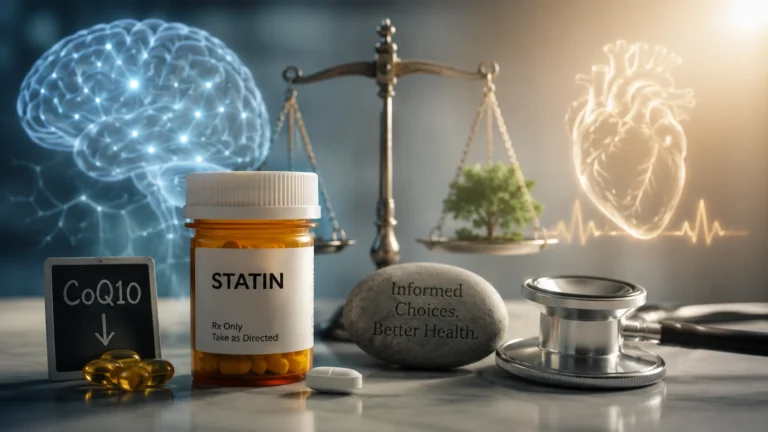
The dangers of statins are easiest to understand when we resist two opposite mistakes: pretending the drugs are harmless, and pretending they never help. Statins can reduce heart-attack and stroke risk for selected patients, especially people with established cardiovascular disease or sufficiently high baseline risk. But the benefit is not identical for everyone, and lowering LDL is not the only biological effect worth discussing.
Cholesterol is not a poison. It is a structural and metabolic building block used in cell membranes, steroid-hormone synthesis, bile acids, vitamin D pathways, and the nervous system. Statins act upstream in the mevalonate pathway, so a responsible long-term decision should ask more than whether LDL falls. It should ask how large the patient’s expected absolute cardiovascular benefit is, what side effects or tradeoffs matter, what remains uncertain, and whether the therapy fits the person’s overall risk profile.
That is the same health-stewardship principle discussed in What Does It Mean to Be Healthy?: better health decisions come from understanding the whole person rather than treating one laboratory number as the entire story.
Table of Contents
What Statins Actually Do
Statins inhibit HMG-CoA reductase, reducing hepatic cholesterol synthesis and increasing LDL-receptor activity. That is why LDL cholesterol usually falls. The same mevalonate pathway also contributes to production of other compounds involved in cellular signaling and energy metabolism, including coenzyme Q10 (CoQ10).
That mechanism does not prove that every downstream change produces clinical harm. It does, however, explain why a medication designed to alter one risk factor can have effects beyond the target number. The useful question is therefore not simply “Does the drug work?” but “For this patient, how much benefit is expected, what adverse effects are plausible, and how should they be monitored?”
Secondary Prevention and Primary Prevention Are Not the Same Decision
For people who have already had a heart attack, ischemic stroke, coronary intervention, or established atherosclerotic cardiovascular disease, statins have substantial evidence for reducing recurrent events. That is an important reason not to generalize from a low-risk patient to a high-risk patient.
Primary prevention is more variable. A person who has never had a cardiovascular event may still benefit if baseline risk is high enough, but the absolute benefit depends heavily on age, smoking, blood pressure, diabetes, LDL level, family history, and overall cardiovascular risk. A relative risk reduction can sound impressive while translating into a small absolute difference for a low-risk individual.
That is why shared decision-making should include absolute risk reduction and the number needed to treat when those estimates are available. The patient deserves to know not only that risk goes down, but approximately how much risk goes down for someone like them.
The CoQ10 Question: An Established Biochemical Effect, an Unsettled Treatment Question
Statins lower circulating CoQ10. That biochemical effect is well documented and biologically plausible because cholesterol and CoQ10 share upstream steps in the mevalonate pathway. CoQ10 participates in mitochondrial electron transport and cellular ATP production, which makes the issue especially relevant to skeletal muscle and other energy-demanding tissues.
What remains less certain is how much CoQ10 depletion explains statin-associated muscle symptoms and whether supplementation reliably improves those symptoms. Trials and reviews have produced mixed results. Some patients report improvement, but the evidence does not justify a universal rule that everyone taking a statin should automatically take CoQ10.
If new muscle pain, weakness, fatigue, or exercise intolerance appears after therapy begins, the better response is clinical review: timing, dose, drug interactions, thyroid function, vitamin D status, exercise changes, and other potential causes should be considered rather than assuming either that the statin must be responsible or that the symptoms cannot be related.
The Brain Is Cholesterol-Rich, but the “95 Percent” Claim Is Wrong
The brain is not 95% cholesterol. That claim should not be repeated. The more accurate and still important point is that the brain contains a disproportionately large share of the body’s cholesterol and depends on tightly regulated cholesterol metabolism for membranes, myelin, synapses, and neuronal signaling.
Brain cholesterol is also largely maintained behind the blood-brain barrier, so serum cholesterol and brain cholesterol are not interchangeable pools. This is one reason simplistic slogans — either “cholesterol is bad” or “lower cholesterol damages the brain” — do not adequately describe the biology.
Statins, Memory Complaints, and Brain Fog
Postmarketing reports have described memory loss, forgetfulness, confusion, and other cognitive symptoms in some statin users. FDA labeling has acknowledged rare cognitive reports that were generally described as nonserious and reversible after discontinuation. That is different from proving that statins commonly cause progressive cognitive decline.
Large observational studies and reviews have been mixed or reassuring at the population level, and vascular-risk reduction may itself protect cognition by reducing stroke and cerebrovascular disease. Still, population averages do not make an individual symptom irrelevant. If a new cognitive complaint begins soon after a medication change, documenting timing, dose, other medicines, sleep, thyroid function, mood, and metabolic factors gives the clinician something concrete to evaluate.
Do Statins Cause Brain Shrinkage?
The claim that statins routinely cause brain shrinkage is not supported as a settled clinical fact. Some observational imaging studies have reported associations between statin use, white-matter findings, or regional brain volumes. Other studies have found no adverse association with hippocampal change or Alzheimer-related imaging biomarkers.
The central limitation is confounding: statin users often have more diabetes, hypertension, vascular disease, obesity, or other risk factors that can themselves affect the brain. Imaging associations are therefore useful for generating questions, not for proving that the medication caused the observed difference. This is an area where longer-term, better-controlled research remains valuable.
Other Risks Patients Should Know About
Muscle symptoms are the most familiar complaint and range from mild aches to weakness; severe rhabdomyolysis is rare. Statins can also cause liver-enzyme elevations and are associated with a modest increase in new-onset diabetes, particularly in people who already have metabolic risk.
Those risks should be interpreted alongside benefit rather than in isolation. A small diabetes risk may be acceptable for a patient with very high cardiovascular risk, while the same tradeoff may look different in a lower-risk patient who is already metabolically vulnerable.
Risk Stratification: When More Information Can Improve the Decision
When a primary-prevention decision is uncertain, clinicians may consider additional risk information rather than treating LDL alone as destiny. Depending on the person, that can include blood pressure, smoking, diabetes, family history, triglycerides, HDL, metabolic health, inflammatory markers, lipoprotein(a), apolipoprotein B, and coronary artery calcium scoring.
Coronary calcium is particularly useful in selected borderline or intermediate-risk adults because it can help distinguish a person with little visible calcified plaque from someone with a much higher atherosclerotic burden than ordinary risk factors suggest. It does not replace clinical judgment, but it can make the conversation less abstract.
Lifestyle Is Foundational, Even When Medication Is Appropriate
Food quality, exercise, smoking cessation, sleep, blood-pressure control, insulin sensitivity, body composition, and stress all influence cardiovascular risk. Medication should not turn these into optional extras. For many patients, the best strategy is not “lifestyle or statin” but an honest assessment of how much risk can be reduced through both.
The related SSJ article How to Prevent Commercial Interests from Stealing Your Health expands the same principle: commercial influence is not proof that a therapy is wrong, but it is one reason patients should understand incentives, alternatives, and long-term tradeoffs rather than outsourcing discernment.
| “The right statin question is not simply “Does LDL fall?” It is “How much does my actual risk fall, and what tradeoffs come with that benefit?”” |
Better Questions Before Starting or Continuing a Statin
| Question | Why It Matters |
| What is my baseline 10-year and lifetime cardiovascular risk? | Absolute benefit depends on starting risk. |
| Is this secondary prevention or primary prevention? | Evidence strength and expected benefit differ substantially. |
| What absolute risk reduction should I expect? | Relative percentages can make modest benefit sound larger. |
| What symptoms should I track? | Timing helps evaluate muscle, fatigue, glucose, liver, or cognitive concerns. |
| Could dose, statin type, or another therapy change tolerability? | Different drugs/doses and non-statin options may change the balance. |
| Would coronary artery calcium or other risk markers clarify uncertainty? | Additional risk stratification can improve borderline decisions. |
| What lifestyle interventions are we using seriously? | Medication should complement, not replace, risk-factor improvement. |
| When will we reassess whether the plan is still appropriate? | Long-term therapy deserves periodic review rather than automatic continuation. |
A Wise Path Forward
If you are already taking a statin — particularly after a heart attack, stroke, stent, bypass, or known coronary disease — do not stop it because of an article. Write down the question or symptom that concerns you and bring it to the prescriber. If the decision is primary prevention, ask for the baseline risk, the expected absolute benefit, the important adverse effects, and the alternatives.
For a broader historical framework on how apparently settled medical practices can later be revised, see Medical Reversals: 130 Years of Health Advice We Later Regretted. The purpose of that series is not to assume today’s medicine is wrong. It is to identify the conditions under which overconfidence, weak long-term evidence, poor risk communication, or commercial incentives can produce preventable harm.
Conclusion: Do Not Trade One Risk for Another Without Understanding the Exchange
Statins can reduce cardiovascular risk in the right patient. They can also produce adverse effects and alter a pathway involved in more than LDL cholesterol. Those two truths can coexist.
The strongest argument is not that statins should never be used. It is that long-term statin therapy should be matched to the individual’s actual risk, expected absolute benefit, tolerance, preferences, and alternatives. That requires more than a laboratory threshold. It requires evidence, monitoring, honest uncertainty, and a clinician-patient conversation in which questions are welcomed.
Good health stewardship does not reject modern medicine, and it does not surrender discernment to it. The goal is not merely a better cholesterol report. The goal is fewer cardiovascular events, preserved function, a clear mind, strong muscles, and a treatment plan whose benefits genuinely outweigh its costs for the person taking it.
Closing CTA
Before starting or renewing long-term statin therapy, ask for a plain-language explanation of your baseline cardiovascular risk, your expected absolute benefit, the most relevant side effects, and what would cause the plan to change. If you are already taking a statin and notice new muscle symptoms, fatigue, glucose changes, or cognitive complaints, document the timing and discuss the pattern with a qualified clinician rather than changing treatment on your own.
Source and Fact-Checking Notes
- USPSTF — Statin Use for the Primary Prevention of Cardiovascular Disease — Risk-based primary-prevention recommendation framework and evidence review. Source
- AHA/ACC — 2019 Primary Prevention Guideline — Guideline framework for cardiovascular risk discussion and selected statin use. Source
- AHA Scientific Statement — Statin Safety and Associated Adverse Events — Broad review of statin safety and adverse-event evidence, including cognition, diabetes, liver, and muscle issues. Source
- FDA — Statin labeling / cognitive reports — Product labeling notes rare postmarketing cognitive symptoms described as generally nonserious and reversible. Source
- PMC — Statin Treatment and Circulating CoQ10 Meta-analysis — Systematic review/meta-analysis reporting reduced circulating CoQ10 with statin treatment. Source
- NCCIH — Coenzyme Q10 — Federal evidence summary describing mixed evidence for CoQ10 supplementation and statin-associated muscle pain. Source
- PMC — Cholesterol Metabolism in the Brain and Neurodegenerative Disease — Supports the brain’s high cholesterol content and specialized CNS cholesterol regulation. Source
- PMC — Statins and Brain Health — Community-based imaging study finding no adverse or protective differences in selected Alzheimer-related imaging biomarkers among long-term statin users. Source
- PMC — Statin Use and Hippocampal Volumes — Observational MRI study finding statin use was not associated with rate of hippocampal-volume change. Source
- PMC — Statin Use and Brain Volumes / White Matter Findings — Observational study reporting associations with white-matter and grey-matter measures; causation limitations are essential. Source
- Mayo Clinic — Statin Side Effects — Patient-facing overview of recognized statin adverse effects and practical context. Source
Source Independence / Bias Check
| Source Type | Bias / Independence Consideration | How SSJ Uses It |
| U.S. government sources (USPSTF, FDA, NCCIH) | Not commercial product sponsors, but they operate within public-health and regulatory frameworks with institutional assumptions and policy mandates. | Use for official guidance, labeling, safety language, and evidence summaries; do not treat agency position as proof that all uncertainty is resolved. |
| Professional-society guideline / scientific statement (AHA/ACC) | Guidelines rely on expert panels whose members may have disclosed academic, clinical, or industry relationships; methodology and conflict disclosures should be reviewed for major claims. | Use for mainstream standard-of-care context and to identify where expert consensus is strong or conditional. |
| Systematic reviews / meta-analyses | Quality depends on included trials, their funding, heterogeneity, outcome selection, and publication bias. A review is not automatically independent because it is peer-reviewed. | Use for direction and consistency of evidence; inspect underlying studies and certainty when a claim is consequential. |
| Observational imaging studies | May receive public, academic, philanthropic, or mixed funding. Even with independent funding, confounding by indication and residual confounding can dominate interpretation. | Treat as association-generating evidence, not causal proof. Compare contrary imaging findings. |
| Patient-facing clinical summaries | Useful for recognized adverse effects and communication, but not substitutes for primary evidence. | Use for practical context only. |
SSJ evidentiary rule: funding source is one bias variable, not a verdict. For major or controversial claims, follow the chain beyond the named funder when material: direct sponsor → upstream donor or foundation transparency → board/executive ties → author conflicts → sponsor control over design/data/publication → independent replication → evidence certainty → credible contrary evidence. Hidden or indirect funding warrants deeper scrutiny, but methodology and reproducibility remain decisive.
Sources and Further Reading
- USPSTF — Statin Use in Adults: Preventive Medication — Read
- AHA/ACC — Primary Prevention Guideline — Read
- FDA — Statin label / cognitive warning language — Read
- NCCIH — Coenzyme Q10 — Read
- PMC — Brain cholesterol review — Read
Disclosure
This article is educational and is not personal medical advice. Statins can reduce cardiovascular events for appropriately selected patients, particularly those with established cardiovascular disease or sufficiently high baseline risk. Side effects, benefit magnitude, and alternatives vary by person. Do not start, stop, reduce, or switch a prescription statin solely because of this article. Discuss symptoms, risk estimates, medication changes, and alternatives with a qualified healthcare professional who knows your medical history.
