

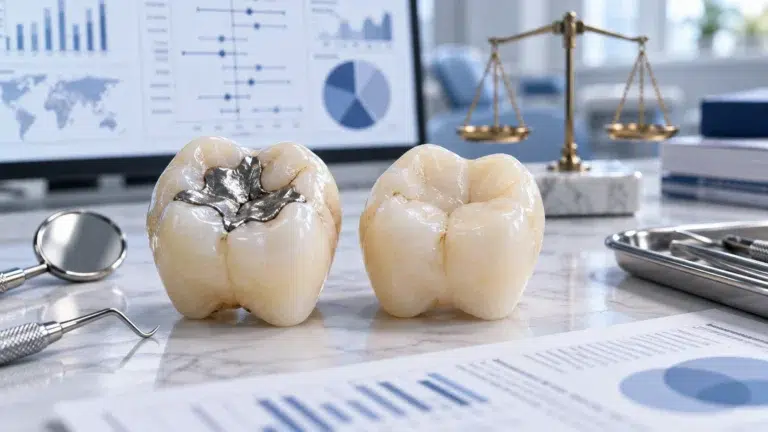
Dental amalgam mercury is one of those health topics where a single fact can sound decisive: the filling material commonly called a “silver filling” is approximately 50% elemental mercury by weight. That is true. It is also true that amalgam has been used for more than 150 years because it is strong, inexpensive, and durable. And it is true that the best available evidence has not demonstrated a clear pattern of systemic harm in the general population from ordinary amalgam exposure.
Those facts do not cancel one another. They create the real question: how should a patient think about a restorative material that contains a known neurotoxic element, releases small amounts of mercury vapor, appears generally safe for most people in available studies, yet is now discouraged by FDA for several higher-risk groups?
This is exactly the kind of evidence problem explored in Medical Reversals: 130 Years of Health Advice We Later Regretted: medicine rarely advances by discovering that everything previously believed was simply false. More often, evidence narrows the claim, identifies vulnerable groups, changes the risk-benefit balance, and introduces better alternatives.
Table of Contents
What Dental Amalgam Actually Is
Dental amalgam is a mixture of liquid elemental mercury with a powdered alloy containing primarily silver, tin, and copper. The mercury allows the material to become workable and then harden into a durable restoration. FDA and the National Institute of Dental and Craniofacial Research both describe amalgam as approximately 50% mercury by weight.
The phrase “silver filling” is therefore visually descriptive but chemically incomplete. Silver is present, but mercury is the component that makes the alloy function as amalgam.
Exposure Is Real — and That Is Not the Same as Proven Harm
Dental amalgam can release low levels of mercury vapor. Exposure can vary with the number and age of fillings and can increase during chewing or tooth grinding. Placement and removal can produce temporary increases in vapor exposure.
Studies also show a biological exposure signal. In the New England Children’s Amalgam Trial, more amalgam surfaces were associated with higher urinary mercury. That is important because it confirms that the material is not biologically inert.
But exposure is not the same thing as injury. The next question is whether the exposure levels produced by ordinary dental use result in measurable adverse health outcomes.
| “The evidence question is not whether amalgam exposes people to mercury. It does. The question is whether that exposure produces clinically meaningful harm — and in whom.” |
What the Randomized Trials Found
One of the most important bodies of evidence comes from randomized trials in children. The New England Children’s Amalgam Trial enrolled 534 children ages 6 to 10 who needed at least two posterior restorations and had no prior amalgam fillings. The children were randomly assigned to amalgam or resin composite and followed for five years.
The amalgam group had higher urinary mercury exposure. Despite that, the trial did not find significant adverse effects on full-scale IQ, memory, visuomotor ability, or a broad battery of neuropsychological outcomes. Follow-up analyses likewise did not find a dose-response relationship between amalgam exposure and the major neuropsychological outcomes examined.
Kidney outcomes were also studied because mercury can be nephrotoxic at sufficient exposure. The overall randomized-trial evidence did not establish clinically important renal injury attributable to amalgam at the exposure levels studied, although individual biomarker findings and subgroup questions have kept the research discussion open.
That is one reason a blanket claim such as “mercury fillings poison everyone” is not supported by the best randomized evidence.
What the Trials Do Not Prove
Randomized trials answer specific questions in specific populations over specific time periods. The major children’s trials involved children age six and older and followed them for about five years. They do not give the same level of certainty for fetuses, pregnant women, nursing infants, children under six, people with kidney dysfunction, people with neurological disease, or people with unusual sensitivity to mercury or other amalgam metals.
They also cannot prove that no rare, delayed, genetically mediated, or highly individual adverse effect exists. “No demonstrated harm in the studied population” is different from “harm is impossible.”
FDA’s High-Risk Groups
In 2020, FDA updated its recommendations after reviewing uncertainty around mercury exposure from amalgam. The agency did not ban dental amalgam, and it continues to state that the majority of evidence does not show harmful health effects in the general population. But FDA strongly encourages non-amalgam restorations when possible and appropriate for several groups that may be more susceptible to mercury exposure.
| FDA Higher-Risk Group | Why FDA Is More Cautious | Practical Implication |
| Pregnant women / developing fetuses | Developing nervous system may be more sensitive; long-term clinical data are limited. | If a new filling is needed, discuss non-amalgam options when clinically appropriate. |
| Women planning pregnancy | Precautionary concern about fetal exposure during a future pregnancy. | Consider restorative alternatives if a new filling is required. |
| Nursing women / infants | Limited long-term data for this exposure context. | Discuss alternatives for new restorations; do not remove intact fillings solely because of nursing. |
| Children, especially under 6 | Developing neurological systems may be more vulnerable; direct clinical data under age 6 are limited. | Prefer suitable mercury-free materials when practical. |
| People with neurological disease | Potential susceptibility plus limited direct clinical evidence in this population. | Individualized dental/medical discussion. |
| People with impaired kidney function | Kidney is a target organ for mercury toxicity; specific clinical data are limited. | Individualized discussion and consideration of alternatives. |
| Known sensitivity / allergy to mercury, silver, copper, tin or zinc | Local or systemic hypersensitivity reactions can occur. | Avoid the offending material and select an alternative. |
This distinction matters. FDA’s recommendation is not a declaration that amalgam causes disease in these groups. It is a precautionary policy response to biological plausibility, mercury toxicity at higher exposures, and limited direct evidence in people who may be more vulnerable.
The 2026 Systematic Review: More Uncertainty Than a Simple Verdict
A 2026 systematic review in the Journal of Dentistry examined health effects associated with dental amalgam and alternative restorative materials. It included 195 studies, with 61 prioritized for detailed narrative synthesis. Only a small number directly compared amalgam with resin-based composite.
The review’s conclusion is useful because it resists easy slogans: both amalgam and non-amalgam materials may be associated with health impacts, but confidence in many findings is limited by the small amount of direct comparative evidence and the heterogeneity of outcomes and study designs.
That is not a satisfying answer for someone looking for “safe” or “unsafe.” It is, however, an honest description of the evidence base.
Amalgam Is Not the Only Material With Tradeoffs
Composite resins and glass ionomer cements are valuable alternatives, but they are not simply “risk-free replacements.” Composite restorations can release small amounts of resin-related compounds, can be more technique-sensitive, and may not last as long in every clinical situation. Glass ionomer materials have different strength and durability characteristics.
Dental material choice is therefore a clinical decision involving tooth location, cavity size, moisture control, expected bite force, durability, esthetics, cost, patient age, medical history, and material sensitivity.
Why Amalgam Has Lasted So Long
Amalgam earned its place in dentistry for practical reasons. It is strong, relatively inexpensive, tolerant of moisture during placement, and often durable in large posterior restorations. Those advantages mattered especially when alternatives were less reliable.
As composite materials and adhesive dentistry improved, the balance changed. The fact that a newer material is available does not prove the older material was inherently reckless. It means the clinical tradeoff can evolve.
Should You Remove Existing Amalgam Fillings?
This is where a well-intentioned response can create unnecessary harm. FDA does not recommend removing or replacing intact amalgam fillings solely to prevent disease when there is no decay beneath them and no medical indication for removal.
Removal can temporarily increase mercury vapor exposure. It also requires drilling away additional tooth structure, which can weaken the tooth and start a larger restorative cycle. Every replacement restoration has a lifespan; repeated replacement can eventually lead to larger fillings, crowns, root-canal treatment, or extraction.
If an amalgam filling is cracked, leaking, associated with recurrent decay, failing mechanically, or linked to a documented hypersensitivity reaction, replacement may be appropriate. The decision should be based on the condition of the restoration, the tooth, the patient’s medical context, and the available alternatives — not merely the emotional impact of the word “mercury.”
| “A material can deserve less use in the future without requiring every intact restoration from the past to be removed.” |
What About “Safe Amalgam Removal” Protocols?
Some dentists use enhanced isolation, high-volume suction, sectioning techniques, external air management, or other measures intended to reduce exposure during amalgam removal. It is reasonable for patients to ask how a dental office controls debris and vapor.
The evidence does not support turning removal itself into a universal detoxification treatment for nonspecific symptoms. When removal is clinically indicated, exposure control is sensible. When the filling is sound, the FDA’s advice remains that preventive removal is generally not recommended.
Policy Is Moving Away From Amalgam — but Policy Is Not the Same as Proof of Harm
Dental amalgam use has been declining for years because tooth-colored alternatives have improved, patients prefer them, and mercury creates environmental-management burdens in addition to patient-exposure questions.
In February 2026, the Indian Health Service announced that it would end the use of mercury-containing dental amalgam in its facilities by 2027. HHS later encouraged state Medicaid programs to restrict or end coverage for amalgam. The American Dental Association, while continuing to describe amalgam as a safe and durable option, also noted the global Minamata Convention decision to phase out most dental-amalgam manufacture, import, and export by 2034, with exceptions when clinically necessary.
Those policy changes are historically important. They do not, by themselves, prove that amalgam caused systemic disease in previous patients. Policy also reflects environmental mercury reduction, availability of alternatives, patient preference, and the precautionary principle.
This Is Why Dental Amalgam Belongs in a Medical Reversals Series
Dental amalgam is not a clean example of “medicine got it wrong and reversed course.” It is a more useful example: a technology can remain effective while the acceptable risk-benefit balance changes.
For decades, amalgam solved a difficult clinical problem better and more cheaply than many alternatives. Over time, alternatives improved. Environmental concerns gained weight. Regulatory agencies became more cautious about potentially susceptible groups. That is what evidence-based change often looks like in the real world: not confession of catastrophe, but narrowing indications and increasing choice.
That is the broader lesson of Medical Reversals: 130 Years of Health Advice We Later Regretted: the goal is not to ridicule yesterday’s medicine. It is to build systems willing to revise today’s practice when the evidence changes.
What the Evidence Actually Supports
| Claim | Evidence Read | What a Careful Reader Should Conclude |
| Dental amalgam contains mercury. | Established fact. | About 50% elemental mercury by weight. |
| Amalgam increases mercury exposure. | Established. | Mercury vapor is released; more amalgam surfaces can raise urinary mercury. |
| Amalgam causes neurological disease in the general population. | Not established. | Randomized child trials did not show neuropsychological harm over five years; observational questions remain. |
| Everyone should remove existing amalgam. | Not supported. | FDA advises against removing intact fillings solely to prevent disease. |
| Some people may warrant extra caution. | Supported as a precautionary judgment. | FDA identifies pregnancy, young children, neurological disease, kidney impairment, and material sensitivity as higher-risk contexts. |
| Mercury-free alternatives are always safer in every respect. | Not established. | Alternatives have their own material, durability, technique, and health/environmental tradeoffs. |
| Amalgam use is declining. | Established. | Clinical alternatives, preferences, environmental policy, and regulatory caution are driving a phase-down. |
| Policy phase-out proves widespread past injury. | No. | Policy decisions incorporate precaution, environment, technology change, and patient preference as well as health evidence. |
A Practical Decision Framework
- If you need a new filling and are in an FDA higher-risk group, ask whether a non-amalgam material is clinically appropriate.
- If you are not in a higher-risk group, ask about expected longevity, cost, esthetics, tooth location, and material tradeoffs rather than assuming one material is universally best.
- If you already have an intact amalgam filling with no decay underneath, do not assume removal is automatically healthier.
- If a filling needs replacement for dental reasons, ask how the dentist controls mercury vapor and debris during removal.
- If you have kidney disease, neurological disease, pregnancy-related concerns, or a suspected metal allergy, bring that history into the dental decision.
- Do not use nonspecific symptoms alone as proof of mercury toxicity. If toxicity is genuinely suspected, evaluation should be medically directed.
Conclusion: Evidence Nuance Is Not Indecision
It would be easy to turn dental amalgam into a morality play. Mercury is toxic, therefore every mercury-containing filling must be dangerous. Or: randomized trials did not show neurological harm, therefore there is nothing to discuss.
Neither position does justice to the evidence.
Dental amalgam produces measurable mercury exposure. The available evidence has not shown clear systemic harm in the general population at ordinary dental exposure. Important data gaps remain for several potentially susceptible groups, and FDA now recommends that those groups avoid new amalgam when possible and appropriate. Existing intact fillings generally should not be removed merely to prevent disease because the removal process carries its own exposure and dental costs.
That is not a contradiction. It is what mature evidence looks like: dose matters, susceptibility matters, alternatives matter, and the right decision for a new filling is not necessarily the right decision for an old one.
| “Good health stewardship does not ask for a slogan. It asks which claim the evidence can actually carry.” |
Source and Fact-Checking Notes
- FDA — Information for Patients About Dental Amalgam Fillings — Primary current U.S. patient guidance: amalgam is ~50% mercury; small vapor release; no conclusive evidence of harm in general population; high-risk groups; intact fillings generally should not be removed solely to prevent disease. Source
- FDA — Dental Amalgam Fillings — Expanded benefit-risk discussion, high-risk populations, bioaccumulation, alternatives, and removal guidance. Source
- FDA — 2020 High-Risk Recommendations — Official rationale for precautionary recommendations in pregnant/nursing women, young children, neurological disease, kidney dysfunction, and metal sensitivity. Source
- NIDCR — What Do I Need to Know About Silver Fillings? — NIH dental institute overview of composition, benefits, vapor release, and current evidence position. Source
- Bellinger et al. — New England Children’s Amalgam Trial — Randomized trial of 534 children ages 6–10 over five years; no significant adverse neuropsychological outcomes from amalgam versus composite. Source
- Bellinger et al. — Dose-Effect Analysis — Follow-up exposure analysis found no evidence that amalgam mercury exposure was associated with adverse neuropsychological outcomes over five years. Source
- Maserejian et al. — Urinary Mercury — Shows dose-response between amalgam surface exposure and urinary mercury, confirming measurable exposure. Source
- Shaw et al. 2026 — Health Impacts Systematic Review — 195 studies; direct comparative evidence limited; heterogeneous outcomes; confidence limited for many comparative health-effect claims. Source
- HHS / IHS — End Amalgam by 2027 — Current 2026 U.S. policy development: IHS moving to mercury-free restorations; important policy context but not proof of past systemic harm. Source
- ADA — Amalgam — Professional-dental perspective: amalgam remains durable and effective; summarizes regulatory actions and evidence position. Source
- ADA — February 2026 Statement — Notes IHS action and global Minamata phase-out trajectory while emphasizing clinical role and material tradeoffs. Source
Sources and Further Reading
- FDA — Dental Amalgam Fillings — Read
- NIDCR — Silver Fillings / Dental Amalgam — Read
- New England Children’s Amalgam Trial — Read
- 2026 Journal of Dentistry Systematic Review — Read
- ADA — Amalgam — Read
- HHS / IHS 2026 Policy Announcement — Read
Closing CTA
If you have an amalgam filling, the first question is not “How fast can I remove it?” Ask whether the filling is sound, whether decay is present, whether you belong to a higher-risk group, and what your dentist expects from available alternatives. If you need a new restoration, ask for the material choice to be explained rather than treated as automatic. Evidence-based health stewardship begins with better questions.
Disclosure
This article is educational and does not provide individualized dental or medical advice. Dental amalgam decisions depend on tooth condition, restoration size and location, age, pregnancy status, kidney and neurological health, allergies, available materials, and clinician judgment. Do not remove an intact filling or delay necessary dental treatment solely on the basis of this article. Discuss individual risks and restorative options with a qualified dentist and, when relevant, a physician.
