

This article is for educational and informational purposes only. It is not financial, investment, tax, legal, or individualized advisory advice. Markets involve risk, and every investor should consider personal goals, time horizon, financial condition, and risk tolerance before making investment decisions.
Most retail investors do not lose money because they are unintelligent. They lose money because the market is designed to pressure them at the worst possible moments.
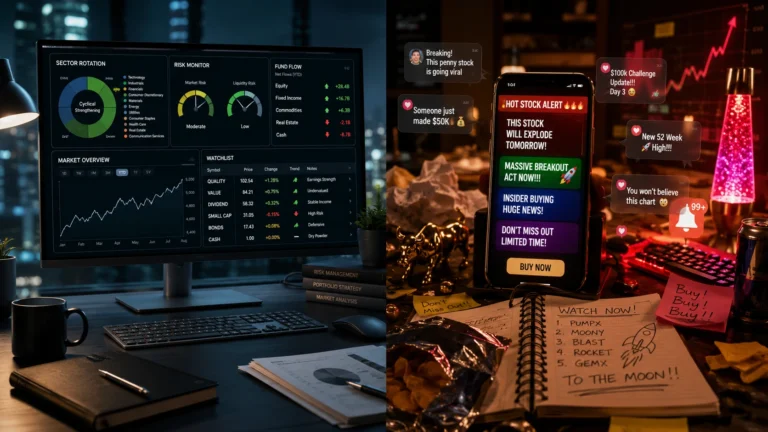
A hot stock appears everywhere at once. A newsletter claims a small company is about to explode. A financial guest on television sounds absolutely certain. A social media thread makes everyone else look rich, early, and confident. The temptation is simple: do something now before the opportunity disappears.
That is the shiny-object trap.
Professional investors are not immune to emotion, mistakes, crowding, or bad judgment. But the better professionals usually approach markets differently. They ask what risk they are taking, who is selling the story, what price already reflects, where liquidity is moving, whether the trend confirms the thesis, and what would prove them wrong.
Six Stone Jars will help you develop that steadier market perspective. The goal is not to make you cynical or frozen. The goal is to help you stop reacting to every shiny object and begin asking better questions before your money is at risk.
[INTERNAL LINK: Current Market Overview: What Is the Market Doing Now?]
Table of Contents
Why Retail Investors Are So Vulnerable to Shiny Objects
Retail investors often receive market information after the most informed money has already moved. By the time a story reaches mass-market headlines, financial television, social media feeds, and promotional email lists, the early phase of the trade may already be gone.
That does not mean every popular idea is wrong. It means popularity is not the same thing as opportunity. A stock can be a wonderful company and still be a poor buy if the price is already stretched. A sector can have a powerful long-term future and still experience painful declines if expectations become excessive. A hot theme can contain real innovation and still attract bad promotions, weak companies, and dangerous timing.
The retail trap is not simply buying the wrong thing. It is buying for the wrong reason: fear of missing out, fear of looking foolish, anger at missing the last move, or confidence borrowed from someone else’s certainty.
That is why investor discipline matters. FINRA warns that volatility can make investors vulnerable to scams promising guaranteed or risk-free returns, and the SEC’s Investor.gov explains how pump-and-dump schemes use false or misleading claims to stir up buying before promoters sell into the excitement. Those are extreme examples, but the underlying psychology is common: excitement can be weaponized.
What Professional Investors Say vs. What They Do
One of the most useful habits you can build is learning to separate what investment houses say from what they do.
Large firms publish market outlooks, strategist notes, portfolio commentary, fund letters, interviews, and conference calls. Some of that material is valuable. Some is marketing. Some is delayed. Some is carefully worded to support a product, calm clients, or maintain flexibility. Professional communication is not always wrong, but it is rarely neutral.
Their actions can tell a different story. Are institutions adding exposure or reducing it? Are managers rotating into defensive sectors while publicly sounding optimistic? Are they raising cash? Are they increasing duration in bonds? Are insiders buying or selling? Are fund flows chasing last year’s winners? Are 13F filings showing concentrated bets, crowded trades, or quiet exits?
Public filings do not give perfect real-time truth. SEC Form 13F reports are generally filed after each quarter and have delays and limitations. They do not reveal every asset, every hedge, or every intention. Still, they are useful because they remind you to look beneath the words. A professional investor’s public message is one data point. Actual positioning is another.
Six Stone Jars will help you build the habit of comparing narrative against evidence. What is being said? What is being bought? What is being sold? What is being hedged? What is being avoided? The difference between the message and the movement is often where the signal begins.
The Typical Retail Investor Traps
Most investment mistakes are not brand-new. They repeat because human nature repeats. The products change. The platforms change. The slogans change. The traps remain familiar.
1. Chasing Performance
Retail investors often buy what has already performed well. This feels logical because recent strength is visible and emotionally reassuring. But chasing performance can lead you to buy after expectations are already high. Morningstar’s Mind the Gap research focuses on the investor return gap – the difference between the return funds produce and the return investors actually experience – because timing decisions and cash flows can reduce real-world results.
2. Confusing a Good Company With a Good Entry
A strong company can be overpriced. A weak company can bounce. A great long-term theme can produce terrible short-term entries. Professional analysis separates business quality, valuation, trend, timing, and risk. Retail excitement often blends them together.
3. Trusting Certainty
The market punishes certainty because the future is never fully known. Anyone claiming a guaranteed outcome is either oversimplifying, selling, or ignoring risk. FINRA defines investment risk as uncertainty that can negatively affect financial welfare. That means risk is not a side issue; it is part of every decision.
4. Reacting to Volatility Instead of Interpreting It
Volatility does not automatically mean sell, and calm markets do not automatically mean safety. Volatility should make you ask what changed, whether liquidity is tightening, whether trend support is breaking, and whether the market is repricing risk.
5. Buying the Story Without Checking the Structure
A story may sound attractive, but you still need structure: trend, price behavior, sector leadership, balance sheet quality, earnings durability, valuation, liquidity, and market regime. Without structure, the story controls you.
[INTERNAL LINK: Future Featured Free article – Technical vs. Fundamental Analysis]
Why the Crowd Is Usually Late
The crowd is usually late because attention moves slower than price.
Professionals watch flows, positioning, sentiment, credit, rates, liquidity, and technical structure. Retail investors often see the finished advertisement: the chart after it already ran, the headline after the move, the pitch after the promoter has built the narrative.
That delay matters. When an idea becomes obvious to everyone, the easy part of the move may already be over. Sometimes the trend can continue, but the risk/reward has changed. The late buyer is no longer buying early opportunity. He may be buying someone else’s exit liquidity.
This is why Six Stone Jars will keep returning to market perspective. The question is not merely, ‘Is this idea exciting?’ The better question is, ‘Where are we in the move?’ Early accumulation, healthy trend, late-stage momentum, crowded optimism, failed breakout, distribution, and reversal are not the same environment. Treating them the same is expensive.
How to Read Investment House Commentary More Wisely
When you read a strategist note, fund letter, or investment-house outlook, do not treat it as a command. Treat it as evidence to examine.
Ask these questions:
• Who benefits if I believe this?
• Is this analysis or product marketing?
• Does the firm’s positioning appear to match the public message?
• Is the recommendation early, timely, late, or already crowded?
• What risks are being minimized or ignored?
• What evidence would prove the thesis wrong?
• Is this idea appropriate for my time horizon and risk tolerance?
Professional Investors Still Make Mistakes
Professional does not mean perfect. Many active managers fail to beat their benchmarks over time, and S&P Dow Jones Indices’ SPIVA scorecards regularly compare active fund performance with passive benchmarks. The point is not that professionals are always right. The point is that the better professional process is more disciplined than the retail impulse to chase whatever is loudest.
You should not blindly copy professionals. You should learn from the process: define risk, test assumptions, use evidence, compare words with behavior, watch the broader market, and know what would change your mind.
That is the difference Six Stone Jars will emphasize. You do not need to pretend you have Wall Street’s resources. But you can stop letting headlines, promotions, and emotional urgency dictate your decisions.
What Six Stone Jars Will Help You Watch
At the free Investment level, Six Stone Jars will help you keep a clear market perspective by watching the visible signals that matter most:
• Major index trend and market posture
• Market breadth and whether strength is broad or narrow
• Sector leadership and sector rotation
• Bond yields and interest-rate pressure
• The dollar and foreign-exchange implications
• Volatility and risk appetite
• Institutional positioning signals where public data is available
• Retail traps, hype cycles, and emotional decision points
[INTERNAL LINK: Future Standard Member article – Weekly Market Analysis: Stock Index, Dollar Index, Bond Index, and Foreign Exchange]
From Free Perspective to Deeper Analysis
The free level will help you see the big picture and avoid knee-jerk reactions. That alone has value because many investors do the most damage when they are reacting emotionally.
The Standard Member level will go deeper into weekly market commentary, informed manager perspectives, asset-class movement, sector and industry strength, and what is changing beneath the surface.
The Investment Member level will go deeper still with macroeconomic indicator work, technical confirmation, market-cycle interpretation, risk analysis, and specific signal-oriented opportunities when conditions warrant.
The purpose is not to overwhelm you. The purpose is to help you move from noise to structure. You do not need more opinions. You need better filters.
A Simple Filter Before You Chase the Next Hot Idea
Before you act on the next hot tip, newsletter pitch, social media thread, or dramatic market headline, pause long enough to ask:
• What is the actual thesis?
• What is the evidence beyond the story?
• Is the move early, mature, or extended?
• What are professionals doing, not merely saying?
• What is the downside if I am wrong?
• What would make me exit?
• Am I acting from discipline or emotion?
If you cannot answer those questions, you may not be investing. You may simply be reacting.
[INTERNAL LINK: Future Investment Member article – Proprietary Technical Analysis of Stocks, Futures, and Foreign Exchange]
Conclusion: Do Not Become the Exit Liquidity
Retail investors often enter the market emotionally, late, and overconfident. Professional investors are not always right, but they usually understand one thing better: markets reward discipline more than excitement.
The goal is not to ignore opportunity. The goal is to stop confusing opportunity with urgency. A true opportunity can survive careful examination. A shiny object usually depends on speed, emotion, and fear of missing out.
Six Stone Jars will help you slow the decision down, widen the perspective, and focus on what matters: trend, risk, valuation, positioning, market structure, sector rotation, and investor behavior.
The market will always have another story to sell you. Your job is to decide whether the story is signal, noise, or bait.
Closing CTA
Before chasing the next exciting market idea, step back and ask what the evidence actually shows. Use the Six Stone Jars Investment pillar to keep your perspective steady, your risk visible, and your decisions grounded in signal instead of noise.
Source and Fact-Checking Notes
The following sources were used to support key claims, provide market context, and help readers examine the topic more deeply. This article is educational and should not be treated as personalized financial advice.
• SEC Investor.gov – Pump and Dump Schemes
• SEC – Guide to Identifying and Avoiding Securities Fraud
• SEC – Frequently Asked Questions About Form 13F
• Investor.gov – Asset Allocation and Diversification
• Morningstar – Mind the Gap US 2025
