

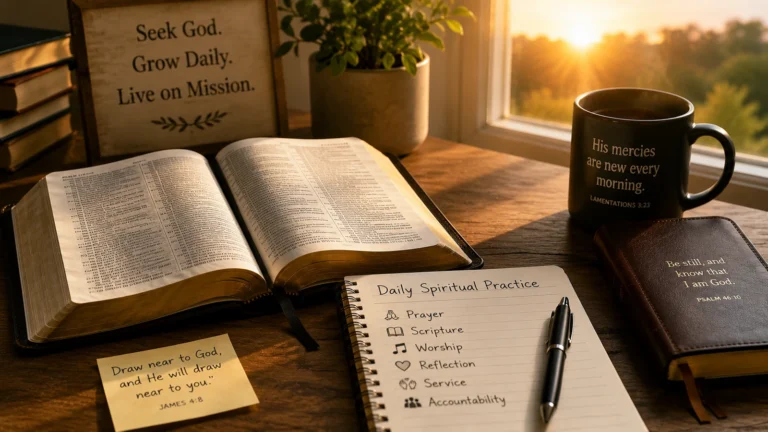
A daily Christian spiritual practice is rarely built through occasional bursts of inspiration. It is formed through repeated acts of attention: turning toward God in prayer, receiving truth through Scripture, worshiping with gratitude, examining the heart honestly, serving other people, and remaining accountable within Christian community.
The purpose of spiritual practice is not to earn God’s love or prove spiritual worth. Christianity begins with grace: salvation is God’s gift, not a reward for flawless religious performance (Ephesians 2:8–10). Spiritual disciplines are therefore not a ladder to salvation. They are ways of responding to grace, remaining close to Christ, and allowing belief to shape thought, character, relationships, and action.
That distinction matters. A rigid checklist can produce pride, guilt, or mechanical religion. A thoughtful rhythm can produce stability, humility, discernment, and love. The goal is not to complete every activity perfectly. The goal is to build a sustainable pattern that repeatedly places your whole life before God.
For a broader foundation, see The Benefits of Christian Spirituality in Your Life, which explains how Christian faith shapes identity, forgiveness, purpose, community, and hope.
Table of Contents
Why a Daily Christian Practice Matters
Every person is being formed by something. News, entertainment, advertising, work pressure, fear, resentment, and social media all train attention and desire. Without an intentional counter-rhythm, the loudest influences of the day can shape the mind before God’s truth has an opportunity to do so.
Jesus modeled deliberate spiritual rhythm. The Gospels repeatedly describe Him withdrawing to pray, engaging Scripture, worshiping in community, serving people in need, and living in accountable relationship with His disciples. Mark 1:35 and Luke 5:16 show that solitude with the Father was not an emergency measure for Jesus; it was part of His pattern.
A daily Christian practice helps believers move from reactive living to rooted living. It creates regular space to remember who God is, who they are in Christ, what matters most, and how they should respond to the day ahead. The point is formation, not spiritual productivity.
| “Every person is being formed by something. A spiritual rhythm decides what receives your first and deepest attention.” |
The Six-Part Daily Practice
A complete daily rhythm can be organized around six mutually reinforcing practices: prayer, Scripture, worship, reflection, service, and accountability. They do not need equal time every day, but together they keep Christian spirituality relational, truthful, embodied, and connected to other people.
1. Prayer: Begin With Relationship, Not Performance
Prayer is not merely presenting requests. It is communion with God: praise, confession, thanksgiving, petition, surrender, listening, and intercession. Jesus’ model prayer begins with God’s name, kingdom, and will before moving to daily needs, forgiveness, and protection (Matthew 6:9–13).
A useful daily pattern is ACTS: Adoration, Confession, Thanksgiving, and Supplication. This prevents prayer from becoming only a list of problems. It also helps align the heart before asking God to change circumstances.
Start with ten focused minutes. Silence notifications, sit or kneel, and pray aloud or in writing. Brief, attentive prayer is more valuable than an ambitious plan that is quickly abandoned.
2. Scripture: Read for Truth, Formation, and Obedience
Scripture gives content to Christian spirituality. Without it, people can easily confuse personal preference, cultural assumptions, or emotional impulses with God’s voice. Second Timothy 3:16–17 describes Scripture as useful for teaching, correction, and training; James 1:22 warns against hearing the Word without doing it.
Use a repeatable reading method. Read a manageable passage, identify what it reveals about God, observe what it reveals about human nature, note a promise or command, and choose one response. The aim is not merely to finish chapters, but to understand and obey.
For most people, one chapter read attentively is more fruitful than several chapters rushed. A structured plan through a Gospel, Psalms, Proverbs, or a New Testament letter can provide continuity without becoming burdensome.
3. Worship: Reorder Affection Through Praise and Gratitude
Worship directs the heart toward God’s worth. It may include singing, spoken praise, thanksgiving, silence, reading a psalm, or listening attentively to a hymn. Worship is larger than music, but music often helps truth move from intellect into affection and memory. Colossians 3:16–17 connects teaching, singing, gratitude, and ordinary action under the lordship of Christ.
Choose one or two worship songs, read a psalm aloud, or write three specific reasons for gratitude. This practice helps displace fear, entitlement, and self-absorption with reverence and thanksgiving.
4. Reflection: Examine the Heart in God’s Presence
Reflection is where spiritual activity becomes spiritual learning. Without reflection, a person may pray, read, and serve while remaining unaware of recurring motives, temptations, wounds, and patterns.
At the end of the day, ask: Where did I notice God’s grace? Where did I resist truth? What produced peace, fear, envy, anger, or joy? Did I treat people as image-bearers? What needs confession, repair, or gratitude? Psalm 139:23–24 gives the posture: invite God to search the heart and lead you in the right way.
This should not become obsessive self-analysis. Christian reflection is practiced in the light of grace. The purpose is honest repentance and growth, not self-condemnation.
5. Service: Convert Devotion Into Love of Neighbor
A spiritual practice that never reaches another person becomes inward and incomplete. Jesus joined love of God with love of neighbor, and James warned against hearing the Word without doing it. Christ Himself described service as central to His mission (Mark 10:45).
Daily service does not require a major project. It may mean encouraging someone, helping a family member, giving generously, listening patiently, forgiving quickly, praying for a coworker, or completing ordinary responsibilities with integrity.
Choose one concrete act of service each day. This turns spiritual insight into embodied obedience.
6. Accountability: Refuse Isolated Christianity
Christian growth is personal, but it is not private. Believers need worship, teaching, correction, encouragement, and relationships in which honesty is possible. Hebrews 10:24–25 connects Christian perseverance with gathering, encouragement, and intentionally provoking one another toward love and good works.
Accountability may include a spouse, trusted friend, pastor, mentor, small group, or ministry partner. The relationship should be marked by confidentiality, truth, prayer, and mutual commitment — not control or surveillance.
A useful weekly conversation can ask: How is your prayer life? What is God teaching you? Where are you being tempted? Is there anyone you need to forgive or serve? What decision requires wisdom? How can I pray for you?
A Practical Daily Schedule
The following structure is designed for sustainability rather than performance. It can be shortened or expanded according to season, responsibilities, health, caregiving, work schedule, and spiritual maturity.
| Time | Approx. Length | Practice |
| Morning | 20–30 minutes | 2 minutes of stillness; 5–8 minutes of prayer; 10–15 minutes of Scripture with one written truth; 3–5 minutes of worship and one act of obedience for the day. |
| Midday | 2–5 minutes | Pause, remember the morning truth, pray briefly, surrender current concerns, and ask whether attitude and action still align with Christ. |
| Evening | ~10 minutes | Review the day with gratitude; confess specific failures; notice grace; identify one repair, service, or accountability action for tomorrow. |
Meaning / impact: the schedule works because it distributes formation across the day. Morning establishes orientation, midday interrupts drift, and evening turns experience into learning. The schedule is a scaffold, not a law. Its success is measured by faithfulness and fruit, not by minutes accumulated.
A Seven-Day Rhythm That Prevents Monotony
| Day | Emphasis | Practical Focus |
| Monday | Surrender and priorities | Dedicate work, responsibilities, and decisions to God. |
| Tuesday | Wisdom | Study a passage related to character, speech, or discernment. |
| Wednesday | Intercession | Pray deliberately for family, church, leaders, neighbors, and people in need. |
| Thursday | Service | Complete a planned act of generosity or practical help. |
| Friday | Examination | Review recurring temptations, attitudes, habits, and unresolved relationships. |
| Saturday | Extended reflection | Journal, walk, study, or spend additional time in quiet prayer. |
| Sunday | Corporate worship and renewal | Gather with believers, receive teaching, serve, and prepare spiritually for the coming week. |
Meaning / impact: a modest weekly emphasis keeps the same core disciplines from feeling repetitive while preserving continuity. It also protects corporate worship and service from becoming optional add-ons to an otherwise private spirituality.
How to Make the Practice Sustainable
Start Smaller Than Your Ambition
Spiritual enthusiasm often creates unrealistic schedules. A dependable fifteen-minute rhythm is better than a ninety-minute plan that lasts three days. Increase depth after consistency is established.
Attach the Practice to an Existing Cue
Connect prayer and Scripture to a stable event: after waking, before coffee, after feeding a pet, during lunch, or before bed. A consistent cue reduces the need to renegotiate the practice every day.
Prepare the Environment
Keep the Bible, journal, reading plan, and pen in one place. Put the phone out of reach. Decide the passage the night before. Small environmental choices remove friction.
Track Faithfulness, Not Spiritual Worth
A simple checkmark can help establish consistency, but the record must never become a scoreboard of righteousness. Missing a day is a signal to resume, not a reason to quit or hide from God.
Adjust for Seasons of Life
Parents of young children, caregivers, shift workers, travelers, people with disabilities, and people facing illness may need shorter or fragmented rhythms. God is not impressed by a schedule detached from responsibility. The practice should serve faithful life, not compete with it.
Common Failure Modes
Turning the Practice Into Legalism
Legalism treats spiritual performance as the basis of acceptance. The corrective is to begin with the gospel: Christ has accomplished salvation. Practice flows from belonging; it does not purchase belonging.
Chasing Emotion
Some days prayer feels vivid; other days it feels quiet. Faithfulness cannot depend entirely on emotional intensity. Feelings matter, but truth provides the foundation.
Consuming Without Obeying
Bible reading, sermons, podcasts, and devotionals can create the illusion of growth without behavioral change. Every practice should eventually answer: What will I believe, stop, begin, repair, or do?
Using Solitude to Avoid Community
Private devotion is essential, but it cannot replace the church. Personal interpretation needs the correction, wisdom, worship, and encouragement of the body of Christ.
Comparing Your Practice With Others
Different believers have different schedules, capacities, callings, and seasons. Comparison can produce pride or discouragement. The relevant question is whether your rhythm helps you remain faithful to Christ in your actual life.
The Role of Grace When You Fail
Every believer will miss days, become distracted, repeat sins, and experience dry seasons. The answer is not to abandon the practice or pretend failure did not happen. It is to return honestly.
Confess what needs confession, receive God’s forgiveness, repair what can be repaired, and begin again. First John 1:9 anchors confession in God’s faithfulness rather than our emotional confidence. A mature spiritual practice therefore includes the habit of returning. Grace does not make discipline unnecessary; it makes renewal possible.
| “A mature spiritual practice includes the habit of returning.” |
A 30-Day Implementation Plan
| Week | Build This Layer | Minimum Sustainable Practice |
| Week 1 | Prayer + Scripture | 15 minutes each morning: about 5 minutes of prayer and 10 minutes of Scripture; record one sentence of application. |
| Week 2 | Worship + Midday Reorientation | Add one worship song or psalm and a two-minute midday pause to remember the morning truth. |
| Week 3 | Evening Reflection + Service | Add 5–10 minutes of evening review and choose one concrete act of service each day. |
| Week 4 | Accountability + Refinement | Share the rhythm with a trusted believer; review what worked, what failed repeatedly, and what is realistic for the next 90 days. |
Meaning / impact: the plan adds practices progressively rather than introducing six disciplines at once. That makes it easier to distinguish genuine resistance from an overloaded schedule and creates a natural point for refinement after thirty days.
What Fruit Should You Expect?
A spiritual practice is not a technique for controlling God or guaranteeing an easy life. Its fruit is usually gradual: greater familiarity with Scripture, quicker repentance, steadier peace, wiser decisions, more disciplined speech, increased compassion, and a deeper ability to recognize temptation and grace.
The New Testament’s clearest measure of spiritual formation is character. Galatians 5:22–23 names love, joy, peace, patience, kindness, goodness, faithfulness, gentleness, and self-control as fruit of the Spirit. That is a better standard than how impressive a routine looks from the outside.
Empirical research on active religious participation also reports associations with social support, civic engagement, several measures of well-being, and in some observational cohorts lower mortality. These findings do not prove Christian doctrine, do not establish that attendance alone causes the outcomes, and do not guarantee benefits for an individual. They are best understood as evidence that embodied community, meaning, behavioral norms, service, and social support can matter to whole-person well-being.
For the larger theological foundation behind these practices, see Why Christianity Is the Best Expression of Spirituality.
Conclusion: Build a Rhythm That Keeps Returning You to Christ
The strongest daily Christian practice is not the most impressive one. It is the one that faithfully returns you to Christ and reshapes ordinary life.
Prayer restores relationship. Scripture supplies truth. Worship reorders affection. Reflection develops honesty. Service converts belief into love. Accountability protects against isolation. Together, these practices form a sustainable rhythm of discipleship.
Begin simply. Protect the time. Remain flexible. Refuse perfectionism. When you fail, return by grace. Over time, repeated attention to God can become a life increasingly marked by wisdom, peace, courage, humility, and love.
And when spiritual practice encounters the harder questions of suffering and evil, the companion article If God Is Good, Why Does God Allow Evil for a Time? places daily faithfulness inside the larger biblical story of creation, fall, redemption, and restoration.
Closing CTA
Choose one realistic starting point today: ten minutes of prayer and Scripture, one written application, and one person who can encourage your consistency. Do not wait for the perfect schedule. Begin with the time and responsibilities God has already placed in your hands. After thirty days, review the fruit — not merely the streak — and refine the rhythm for the next season.
Source and Fact-Checking Notes
- Bible Gateway — Matthew 6:5–13 — Jesus’ teaching on prayer and the Lord’s Prayer. Source
- Bible Gateway — Mark 1:35; Luke 5:16; Luke 6:12 — Jesus’ repeated pattern of solitary prayer. Source
- Bible Gateway — Ephesians 2:8–10 — Grace, faith, and good works in their proper order. Source
- Bible Gateway — 2 Timothy 3:16–17; James 1:22 — Scripture for teaching/training and the necessity of obedience. Source
- Bible Gateway — Colossians 3:16–17 — Worship, teaching, gratitude, and ordinary action under Christ. Source
- Bible Gateway — Psalm 139:23–24; 1 John 1:9 — Self-examination, confession, and grace. Source
- Bible Gateway — Mark 10:45; Hebrews 10:24–25 — Service and Christian community/accountability. Source
- Bible Gateway — Galatians 5:22–23 — Fruit of the Spirit as a character-centered measure of formation. Source
- Pew Research Center — Religion’s Relationship to Happiness, Civic Engagement and Health — Cross-national survey evidence on active religious participation; supports limited social/well-being context, not theological truth. Source
- PMC — Religious-service attendance and subsequent health and well-being throughout adulthood — Prospective observational evidence across three cohorts; associations require confounding caution. Source
- PMC — Attendance at Religious Services, Prayer, Religious Coping, and Health — Black Women’s Health Study; observational association with mortality. Source
- PMC — Frequency of Attendance at Religious Services and Mortality in a U.S. National Cohort — NHANES-linked cohort; lower mortality association after adjustment; observational, not causal proof. Source
Sources and Further Reading
- Bible Gateway — Matthew 6 — Read
- Bible Gateway — Colossians 3 — Read
- Bible Gateway — Galatians 5 — Read
- Pew Research Center — Our Funding — Read
- PMC — Religious-service attendance and subsequent health and well-being — Read
Disclosure / Interpretive Note
This article presents a biblical Christian framework for spiritual formation and practical discipleship. Spiritual disciplines do not earn salvation, guarantee emotional intensity, secure material prosperity, or ensure particular health outcomes. The proposed schedule is adaptable for disability, caregiving, shift work, trauma, illness, and different seasons of life. Empirical studies cited here report associations involving religious participation and well-being; they do not prove Christian doctrine or establish that religious attendance alone causes better health outcomes.
