

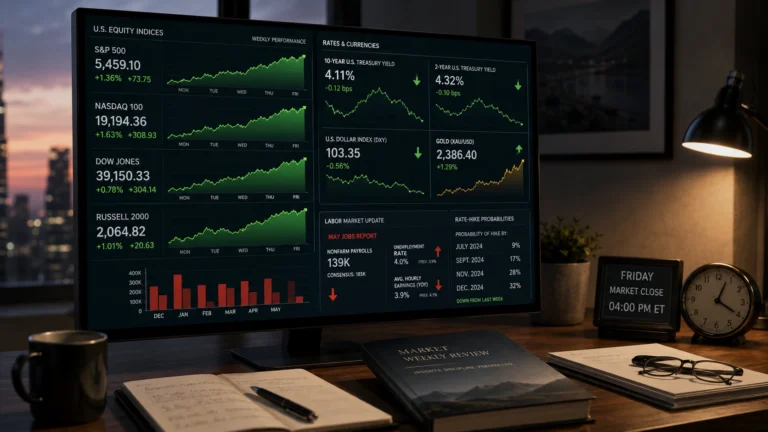
The week ending Friday, August 7, 2026 delivered one of those market moments that can confuse investors if they only read the headline. Stocks surged, the S&P 500 closed at a record high, and the Nasdaq posted its strongest weekly gain since April. Yet one of the biggest catalysts was a surprisingly weak U.S. jobs report.
That sounds backward until you remember that markets do not simply reward “good” economic news and punish “bad” news. Markets price expectations. When July payrolls unexpectedly fell, investors quickly reduced the odds that the Federal Reserve would raise rates at its September meeting. Treasury yields declined, the dollar weakened, and risk assets rallied.
The result was a constructive week for equities—but not an uncomplicated one. The market is celebrating lower rate pressure while the labor market is showing signs of losing momentum. That tension is the signal beneath the headline.
The Market in One Sentence
Risk appetite strengthened sharply as weaker labor data reduced rate-hike expectations, but the rally now faces an important inflation test.
Weekly Market Dashboard
| Indicator | Friday Close / Level | Weekly Read |
| S&P 500 | 7,757.64 | Up 3.58%; record Friday close |
| Nasdaq Composite | 26,690.62 | Up 5.19%; strongest major-index gain |
| Dow Industrials | 54,036.93 | Up 2.96% |
| 2-Year Treasury | 4.19% | Down 9 bps from Jul. 31 |
| 10-Year Treasury | 4.65% | Down 10 bps from Jul. 31 |
| 30-Year Treasury | 5.19% | Down 8 bps from Jul. 31 |
| Dollar Index | 99.61 | Down 0.3% Friday |
| Gold | ~$4,414/oz | Nearly +7% for week |
| Brent crude | ~$82/bbl | Down 0.7% Friday; geopolitical risk remains |
1. Stocks: A Strong Week, Not Just a Strong Friday
The S&P 500 rose 0.62% Friday to 7,757.64, setting a record close. For the week, it gained 3.58%. The Nasdaq Composite climbed 5.19% for the week, while the Dow gained 2.96%. Reuters reported that all three major indexes recorded their biggest weekly percentage gains since April.
That is clearly constructive market action. It also reinforces an idea discussed in Long-Term vs. Short-Term Investing: Avoid the Noisy News and Keep Your Eye on the Prize. A single day can be dramatic, but the better question is whether the move changes the larger trend and whether other markets confirm it.
Friday’s participation was also reasonably broad: advancing stocks outnumbered decliners by about 2.5-to-1 on the NYSE and 2.1-to-1 on the Nasdaq. That does not prove a durable breakout by itself, but it is healthier than an index advance carried by only a handful of mega-cap stocks.
2. The Jobs Report Changed the Rate Conversation
The most important macro event of the week arrived Friday morning. The Bureau of Labor Statistics reported that nonfarm payroll employment fell by 23,000 in July. The unemployment rate was 4.1%, down slightly from 4.2% in June, but the decline occurred as some workers left the labor force.
The revisions were also important. BLS revised May payroll growth down by 66,000 and June by 37,000. Together, those two months were 103,000 jobs weaker than previously reported.
Markets responded immediately because labor weakness changes the Federal Reserve debate. Reuters reported that the market-implied probability of a September rate hike fell to roughly 44%, from 55% the prior session and 67% a week earlier.
This is the classic “bad news can be good news for stocks” mechanism: weaker economic data can reduce pressure for tighter monetary policy. But investors should not stop the analysis there. A labor market that weakens too far can eventually become an earnings and consumer-demand problem.
3. Bonds: Yields Fell, but Long Rates Are Still High
Treasury yields moved lower after the jobs report. According to the U.S. Treasury’s official interest-rate data, the 2-year yield ended Friday at 4.19%, down from 4.28% on July 31. The 10-year yield fell to 4.65% from 4.75%, and the 30-year yield eased to 5.19% from 5.27%.
That decline helped equity valuations because a lower discount rate generally reduces some pressure on growth stocks. It also reflected lower expectations for near-term policy tightening.
But yields are not low. A 10-year yield around 4.65% and a 30-year yield above 5% still represent meaningful competition for capital and meaningful borrowing costs across mortgages, corporate debt, and government finance. So the bond message is better described as “pressure eased” rather than “rates are no longer a problem.”
This is where the distinction between price action and underlying drivers matters. Technical vs. Fundamental Analysis explains why chart strength is most useful when it is interpreted alongside rates, earnings, liquidity, and the economic backdrop.
4. The Dollar and Gold: A Clear Cross-Market Confirmation
The U.S. dollar weakened as rate-hike expectations fell. Reuters reported the dollar index down about 0.3% Friday to 99.61. Gold moved in the opposite direction, rising roughly 2.6% Friday to about $4,414 an ounce and gaining nearly 7% for the week—its strongest weekly performance since mid-January.
That combination makes sense: lower Treasury yields and a softer dollar can improve the relative appeal of gold. For the free weekly overview, the important point is not to turn one week into a long-term forecast. It is to recognize that bonds, the dollar, and gold were all reacting to the same shift in rate expectations.
5. Oil: The Inflation Risk Has Not Gone Away
Brent crude traded around $82 per barrel Friday and fell about 0.7% on the day, but oil remained highly sensitive to developments involving Iran and the Strait of Hormuz. That matters because energy prices can feed directly and indirectly into inflation expectations.
This creates a difficult policy combination: softer employment argues for restraint from the Fed, while renewed oil pressure could reinforce inflation. The market rallied because the labor report reduced immediate rate-hike fears. The next question is whether the inflation data validates that optimism.
6. Earnings: A Major Support Under the Rally
Weak jobs were not the only reason stocks advanced. Corporate earnings remained a major source of support. Reuters reported that, among 436 S&P 500 companies that had reported through Friday morning, 85.1% had exceeded analyst expectations—well above the long-term average cited by LSEG.
That helps explain why the market could absorb weaker economic data without immediately interpreting it as recessionary. Investors were looking at a softer labor market, but they were also looking at strong reported profits and continued enthusiasm around AI-related spending.
7. Market Posture: Constructive, but the Message Is Mixed
The simplest label for the week is constructive or risk-on. Major indexes rose sharply, the S&P 500 set a record close, breadth was positive Friday, and lower yields supported valuations.
The more useful description is: constructive price action with a mixed macro message.
Three facts deserve to sit next to one another:
- Stocks are showing strong momentum.
- The labor market weakened more than expected.
- Inflation and oil remain unresolved risks.
That is why Six Stone Jars does not want readers to reduce the entire market to one bullish or bearish headline. Markets are systems. A useful weekly overview asks whether stocks, bonds, currencies, commodities, earnings, and economic data are reinforcing one another—or pulling in different directions.
That discipline is especially important for retail investors. Retail vs. Professional Investors: Ignore the Shiny Objects and Avoid the Typical Traps focuses on the tendency to chase whatever is already loud, fast, and emotionally compelling instead of waiting for multiple pieces of evidence.
8. What to Watch Next Week
The week ahead has two obvious macro tests.
Wednesday, August 12: July Consumer Price Index
The Bureau of Labor Statistics release calendar scheduled July CPI for 8:30 a.m. Eastern on August 12. This report matters because the market just reduced expectations for a September rate hike. If inflation is hotter than expected, some of Friday’s rate relief could reverse. If inflation is contained, the market may gain more confidence that the Fed can remain patient.
Thursday, August 13: July Producer Price Index
PPI will provide another read on inflation pressure in the production pipeline. It is less visible to the public than CPI, but it can affect rate expectations and the earnings outlook.
Other Signals to Watch
- 10-year Treasury yield: Does it hold near or below the 4.65% area, or begin climbing again?
- Market breadth: Does participation stay broad, or does leadership narrow back toward a small group of technology names?
- Dollar index: Does the softer-dollar trend continue if rate-hike expectations remain lower?
- Gold: Does strength persist as yields and the dollar adjust?
- Oil and the Strait of Hormuz: Does renewed geopolitical pressure push energy prices back toward an inflationary problem?
- Earnings: Do strong results remain broad enough to offset concerns about slower employment growth?
9. Investor Discipline: Do Not Confuse a Rally With an All-Clear
One of the easiest mistakes after a week like this is to feel that you missed something and need to catch up immediately. That is exactly when discipline matters.
A strong week is information. It is not a command.
The market is telling us that investors currently prefer the combination of strong earnings and lower near-term rate pressure. That is useful. But the same week also told us that job growth is weaker than previously understood and that long-term interest rates remain elevated.
A disciplined investor can hold both ideas at once.
The Bottom Line
The week ending August 7 was decisively positive for U.S. equities. The S&P 500 closed at a record, the Nasdaq surged more than 5% for the week, and market breadth improved Friday. Treasury yields and the dollar fell as weak employment data reduced expectations for a September Federal Reserve rate increase. Gold confirmed that shift with a powerful weekly advance.
But the rally does not eliminate the underlying tension. Markets are responding positively to slower labor growth because it reduces rate pressure. If employment weakens too far—or if inflation remains stubborn because of energy or other pressures—the story changes.
For now, the free Six Stone Jars read is straightforward: market posture is constructive, risk appetite is strong, and the immediate rate backdrop improved. The next confirmation—or contradiction—comes from inflation.
Closing CTA
Start with orientation before you move to interpretation or signals. Six Stone Jars Free readers receive the weekly big-picture market view; Standard Members can go deeper into the cross-market context and informed market commentary; Investment Members can examine the macro, capital-flow, and technical evidence that may turn context into actionable market intelligence.
Next in this weekly series: Weekly Market Analysis — Standard Membership and the corresponding Investment Member market-signals article will extend this same August 7 market story at progressively deeper levels.
Source and Fact-Checking Notes
| Claim Area | Fact-Checking Note |
| Major indexes and weekly performance | Reuters reported the S&P 500 at 7,757.64, Nasdaq at 26,690.62, and Dow at 54,036.93 on August 7, with weekly gains of 3.58%, 5.19%, and 2.96%, respectively. Source: Reuters |
| Employment | BLS reported July nonfarm payroll employment at -23,000 and unemployment at 4.1%. May and June payrolls were revised down by a combined 103,000. Source: BLS Employment Situation |
| Fed expectations | Reuters reported market-implied September rate-hike probability around 44% after the jobs report, down from 55% the prior session and 67% one week earlier. Source: Reuters |
| Treasury yields | U.S. Treasury official par-yield data show Aug. 7 levels of 4.19% (2-year), 4.65% (10-year), and 5.19% (30-year). Source: U.S. Treasury |
| Dollar, gold, oil | Reuters reported the dollar index near 99.61, gold near $4,414/oz and almost +7% for the week, and Brent around $82/bbl Friday. Source: Reuters |
| Breadth and earnings | Reuters reported advancing issues outnumbering decliners 2.49:1 on the NYSE and 2.07:1 on Nasdaq Friday. It also reported 85.1% of 436 S&P 500 companies that had reported through Friday morning had exceeded analyst expectations, based on LSEG data. Source: Reuters |
| Upcoming inflation releases | BLS scheduled July CPI for Aug. 12 and July PPI for Aug. 13, 2026, both at 8:30 a.m. ET. Source: BLS 2026 release calendar |
Sources and Further Reading
The following sources were used to support key claims, provide market context, and help readers examine the topic more deeply. This article is educational and should not be treated as personalized financial advice.
U.S. Department of the Treasury — Interest Rate Statistics — Official Treasury par-yield curve data.
