Table of Contents
The problem is not simply whether a Christian baseball player should be free to write a Bible verse on his cap. The deeper question is whether professional sports can enforce neutral uniform standards while simultaneously asking players to wear symbols associated with social or political causes. A consistent answer must protect both team identity and individual conscience; including the point of MLB players Bible verses on uniforms.
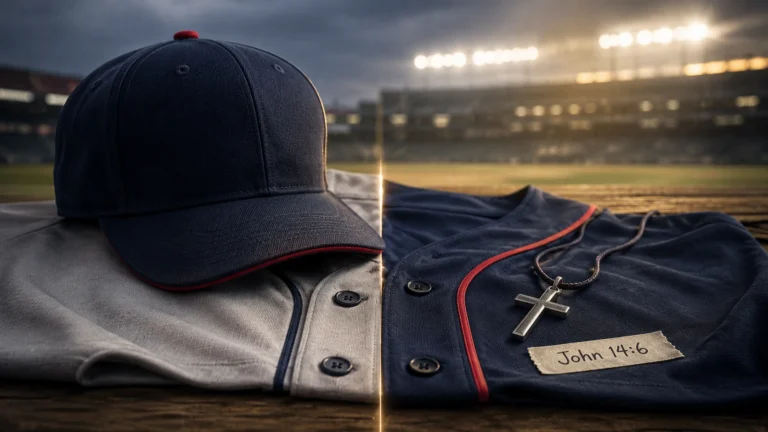
In June 2026, that conflict became visible during the San Francisco Giants’ Pride Night. Pitchers Landen Roupp, JT Brubaker, and Ryan Walker wrote Bible references on rainbow-logo caps, while Sam Hentges wore the standard team cap. Major League Baseball initially issued a routine warning because league rules prohibit players from adding personal messages to uniforms or equipment. Commissioner Rob Manfred later clarified that the players would not be fined or disciplined and that the Giants had failed to clearly tell them they could opt out of the Pride-themed caps.
That outcome points toward a workable principle: leagues may regulate official uniforms, but they should not compel players to display an ideological or moral message that conflicts with sincere religious beliefs. Players, in turn, should generally express their beliefs through permitted channels rather than unilaterally altering official equipment.
The First Amendment Is Important—but It Is Not the Whole Legal Answer
Public discussion often begins with the First Amendment. The First Amendment protects freedom of speech and the free exercise of religion from government interference. Major League Baseball and its individual clubs, however, are generally private employers rather than government agencies. That means a player usually cannot defeat a private league rule merely by saying, “The First Amendment gives me the right to put any message on my uniform.”
This distinction matters. Constitutional free-speech protections normally require “state action”—some meaningful governmental involvement. A privately negotiated uniform rule in a professional sports league is ordinarily governed by employment law, contract law, the collective bargaining agreement, and league policy rather than by a direct First Amendment claim.
Nevertheless, religious liberty does not disappear simply because the employer is private. Title VII of the Civil Rights Act of 1964 prohibits religious discrimination and requires covered employers to reasonably accommodate sincerely held religious beliefs and practices unless the accommodation would impose an undue hardship on the business.
In Groff v. DeJoy, the U.S. Supreme Court clarified that an employer must show a substantial burden in the overall context of its business—not merely a trivial inconvenience—to establish undue hardship. In a uniform dispute, the practical question becomes whether allowing a player to wear the ordinary team cap instead of a cause-themed cap would materially burden league operations. In most circumstances, that would appear to be a modest and workable accommodation, although each situation depends on its facts and governing agreements.
Uniform Rules Can Serve a Legitimate Purpose
A professional uniform is not merely clothing. It identifies the club, supports competitive integrity, fulfills licensing and sponsorship agreements, and presents a consistent public image. A league therefore has legitimate reasons to prohibit players from writing personal messages on caps, jerseys, shoes, or equipment during games.
Without a neutral rule, uniforms could become an uncontrolled forum for political slogans, commercial promotions, personal protests, religious declarations, and messages that teammates or fans find offensive. A player’s message may be sincere and admirable, but the league still needs a manageable standard that applies to everyone.
For that reason, the best argument is not that Christian players should receive an unlimited right to modify uniforms. The better argument is that the league should apply one content-neutral rule: no unauthorized personal messages on official uniforms—and no compelled cause-based messages either.
Recent Baseball Cases and What Actually Happened
| Case | Player action | League or club response | Practical lesson |
| San Francisco Giants, June 2026 | Three pitchers added Bible references to Pride-themed caps; another wore the normal cap. | MLB gave a routine oral warning for unauthorized writing. Commissioner Manfred later confirmed there would be no fine or discipline and said players should have been told they could opt out. | Opting out through an approved accommodation is legally and operationally stronger than altering the uniform. |
| Tampa Bay Rays, June 2022 | Jason Adam, Jalen Beeks, Brooks Raley, Jeffrey Springs, and Ryan Thompson declined rainbow-logo caps and jersey patches, citing faith. | The players were allowed to use standard team logos; no league punishment was reported. | A voluntary opt-out can preserve both player conscience and the team’s ability to hold a themed event. |
| MLB policy shift, 2023 | After disputes over cause-themed uniform elements, MLB generally moved away from allowing local cause-specific modifications to game uniforms. | Commissioner Manfred said the change was intended to avoid placing players in positions that made them uncomfortable because of personal views. | The cleanest policy is to keep game uniforms uniform and move advocacy to voluntary, non-uniform channels. |
| York Revolution, June 2026 | Several players on an independent Atlantic League club declined scheduled Pride jerseys. | The club chose to forfeit the game and continue Pride Night as a non-game event. The team said it would not force players to wear jerseys they were uncomfortable wearing. | When promotional messaging becomes a condition of playing, the event can overshadow the sport and create avoidable conflict. |
These examples do not show a broad pattern of MLB players being fined merely for professing Christianity. The June 2026 Giants players were not punished, and the Rays players who opted out in 2022 were permitted to play in standard uniforms. Accuracy matters: overstating the record weakens an otherwise legitimate concern about viewpoint neutrality and compelled expression.
Are Players “Forced” to Wear Pride Uniforms?
The answer depends on the team, season, and policy in effect. In 2022, some clubs used Pride-themed caps or patches, but the Tampa Bay Rays allowed dissenting players to wear standard versions. By 2023, MLB had generally discouraged cause-specific game-uniform modifications, partly to avoid forcing players into messages that conflicted with their personal beliefs. In the 2026 Giants incident, Commissioner Manfred stated that participation was voluntary and acknowledged that the club had not communicated the opt-out clearly enough.
Accordingly, it would be inaccurate to say that MLB currently has a league-wide rule forcing every player to wear Pride symbols. The more defensible criticism is that teams and leagues sometimes create strong institutional pressure by placing an approved social message on the official uniform while prohibiting players from adding a counter-message. Even when a formal opt-out exists, it must be clearly communicated and free from retaliation to be meaningful.
Pride Symbols and Bible Verses Should Be Judged by the Same Standard
A league cannot credibly claim that uniforms must remain free from personal or ideological messages while the league itself converts those uniforms into vehicles for selected causes. A rainbow emblem may be understood by supporters as a message of welcome and human dignity. A Christian player may nevertheless understand wearing it as personal endorsement of beliefs about sexuality, marriage, or identity that conflict with Scripture. Both realities can be acknowledged without contempt for either group.
Likewise, a Bible reference may be understood by a Christian player as a peaceful statement of faith, while others may see its placement on a Pride-themed cap as a direct rebuttal to the event. That is precisely why official game uniforms are a poor place for competing moral declarations. The uniform should represent the team, not require every player to become a spokesman for a cause.
A Christian Response Must Combine Conviction with Love
Christians should defend religious liberty without treating people as enemies. Scripture calls believers to speak truth in love, to treat every person with dignity, and to remain faithful even when cultural expectations conflict with biblical conviction. Those duties operate together.
A player who declines a symbol for reasons of conscience should explain the decision respectfully: “I value every fan and teammate as a person. I do not hate or reject anyone. However, I cannot personally display a message that I understand to affirm beliefs contrary to my faith.” That is not the same as insulting, excluding, or mistreating another person.
The same standard should protect an athlete of any faith—or no faith—who objects to compelled political, religious, or social messaging. Religious liberty is strongest when it is defended as a universal principle rather than a privilege reserved only for one’s own side.
The Better Policy: Keep Advocacy Voluntary and Keep Game Uniforms Neutral
Professional leagues can welcome diverse fans without turning players into unwilling billboards. A fair policy would contain four elements:
- Official game uniforms remain limited to team, league, safety, memorial, and authorized commercial elements—not political, religious, or social advocacy.
- Players may not add unauthorized personal messages, regardless of whether the message is Christian, progressive, patriotic, political, or commercial.
- No player is required to wear a cause-themed symbol that conflicts with a sincerely held religious or moral belief; the standard team uniform is always an available accommodation.
- Teams may hold voluntary community events, display stadium signage, support charities, and invite fans to participate—without making ideological agreement a condition of playing.
This approach does not silence anyone. It separates the playing uniform from the marketplace of ideas. Players remain free to discuss their faith in interviews, social media, charitable work, chaplaincy programs, voluntary apparel, and league-approved personal-expression events. Teams remain free to serve and welcome their communities. The game itself remains a shared civic space rather than a compulsory political platform.
Should Players Be Allowed to Add Bible Verbiage?
As a matter of conscience and cultural fairness, Christian expression deserves the same respect afforded to other viewpoints. As a matter of uniform governance, however, players should not possess an unlimited unilateral right to write messages on official game apparel. A rule allowing only favored messages would be discriminatory; a rule allowing every message would be unworkable.
The principled answer is therefore conditional:
- No—players should not independently alter official uniforms when a neutral rule prohibits all unauthorized messages.
- Yes—leagues should accommodate sincere religious objections by allowing the standard, unmodified uniform instead of a cause-themed version.
- Yes—players should have broad freedom to express their faith through approved channels that do not compromise uniform consistency or competitive operations.
- No—teams should not compel players to display Pride, political, religious, or other ideological symbols as a condition of participation.
Conclusion: Sports Should Unite Around the Game
Professional sports bring together people who disagree about religion, politics, sexuality, and culture. That unifying power is weakened when the uniform becomes a test of ideological conformity.
Major League Baseball is justified in enforcing a neutral rule against unauthorized uniform modifications. But neutrality must work in both directions. A league should not forbid a player’s personal religious message while using the official uniform to require support for a league-selected social message. The proper solution is not a contest over which ideology controls the jersey. It is to keep advocacy voluntary, protect religious accommodation, and let the uniform represent the team and the game.
Christians can support that solution with confidence and grace: defending conscience without hostility, affirming the dignity of every person without surrendering biblical conviction, and insisting that genuine inclusion must include those whose sincere beliefs differ from the prevailing institutional message.
Call to Action
When debates about faith and public life become emotionally charged, begin by separating facts from assumptions. Ask whether the rule is truly neutral, whether participation is genuinely voluntary, and whether respectful accommodation is available. Religious liberty is preserved not by demanding special privilege, but by applying consistent principles to everyone.
Source and Fact-Checking Notes
The following sources were used to support key claims, provide background context, and help readers examine the topic more deeply. Scripture and external references are included for transparency and further study.
- Associated Press — MLB warning and Giants Pride Night facts
- Sen. Josh Hawley — June 16, 2026 letter and supporting documents
- Sen. Josh Hawley — MLB response confirming no punishment
- EEOC — Religious discrimination and reasonable accommodation
- U.S. Supreme Court — Groff v. DeJoy, 600 U.S. 447 (2023)
- Associated Press / Guardian — Tampa Bay Rays players opt out, June 2022
- York Revolution — Club statement on June 2026 Pride Night forfeiture
